
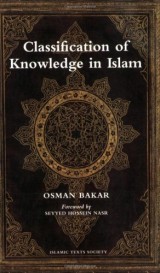
Classification of Knowledge in Islam: A Study of Islamic Philosophies of Science
by Osman Bakar
Introductory essay by Mehdi Golshani
This is the first contemporary book on the classification of sciences in Islam, written by a Muslim scholar in the contemporary language. Professor Osman Bakar, who is currently Senior Research Fellow and Deputy Chief Executive Officer of the International Institute of Advanced Islamic Studies of Malaysia, brings out the metaphysical basis which underlies each of the three classification schemes under his study.
Two major ideas shaped the underlying philosophical basis of all these classifications (1) the hierarchy and unity of the sciences and (2)the distinction between religion and philosophy.
Among the peripatetic philosopher-scientists who had dealt with the subject, he chose al-F─ür─üb─½ (258/870-339/950) whose classification of the Sciences was the first influential one in Islam and had major impact on the following generations of Muslim scholars and on the medieval West.
Al-F─ür─üb─½’s classification of the sciences is best presented in his book Kit─üb Ihs─ü’ al-Ul┼½m (The Book of the Enumeration of Sciences) where he classified all fields of knowledge into the following categories: the linguistic, the logical, the mathematical, the physical, the metaphysical, and the political (which included political science, jurisprudence, and dialectical theology).
Al-F─ür─üb─½ gave three criteria by means of which the hierarchy of the sciences might be established: the nobility of the subject matter, the profundity of the proofs, and the magnitude of the benefits. In al-F─ür─üb─½’s view, metaphysics is the most useful of sciences as far as man’s final perfection is concerned.
Al-F─ür─üb─½ tried to harmonize Greek philosophical ideas with Islamic beliefs.
The second scholar chosen by the author was al-Ghazz─ül─½ (450/1058-505/1111), an Ash’ar─½te theologian and Sufi, who had a strong impact on the successive generations of Muslim scholars and on the destiny of the philosophical sciences in Islamic lands. Al-Ghazz─ül─½’s classification of sciences is laid out in several of his works, and Professor Bakar mentions all of them. But, in my view, al-Ghazz─ül─½’s most extensive classification is the one done presented in the first chapter of his monumental work Ihy─ü’ Ul┼½m al-D─½n (The Revivification of the Religious Sciences). Here, his main classifications are religious and intellectual (or non-religious) sciences which, in turn, have some subdivisions.
Finally, the author considered Qutb al-D─½n Sh─½r─üz─½ (634/1236 – 710/1311) who was a philosopher-scientist, well versed in the philosophy of Ibn S─½n─ü as well as Suhraward─½, who was one of the eminent scientists of the Islamic civilization era.
Qutb al-D─½n Sh─½r─üz─½ ‘s classification of the sciences was mainly done in his book Durrat al-T─üj (The Pearl Crown) which is really a Persian encyclopedia of Peripatetic philosophy. There, he divides knowledge into philosophical and non-philosophical categories.The latter is, in turn, divided into the religious and non-religious. Qutb al-D─½n divides religious sciences into (1)transmitted, (2)intellectual, and (3)both transmitted and intellectual sciences. In his classification, Qutb al-D─½n emphasizes the philosophical sciences. In all of these classifications, the highest knowledge is the knowledge of God, and it is for the sake of this knowledge that other forms of knowledge are sought.
Professor Bakar has used primary sources for this work and has been faithful to the Islamic intellectual tradition. His book is a major contribution to the study of the classification of the sciences as well as the Islamic philosophy of science.