by Robert (Bob) White FRS, a Professor of Geophysics at Cambridge University, Director of The Faraday Institute for Science and Religion and a Fellow of ISSR. This obituary will be published in Science and Christian Belief, vol. 32(2).
Championed the dangers of global climate change and the hope that Christian faith provides
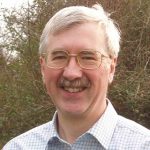
Sir John Houghton, who died on 15 April 2020 at the age of 88 was an outstanding scientist and a man of deep Christian faith. He was a shining example of the way one’s Christian faith should be interwoven with one’s professional expertise and influence. He brought the reality and dangers of climate change and environmental degradation to the attention of both the secular and the Christian world. This was long before most people had woken up to the impact humans are having on what is the only home for nearly 8 billion people. The Covid-19 pandemic has made clear to everyone the inter-relatedness of us all and how small the planet is when a virus can travel around it at the speed of a jet airliner. Global climate change is an even greater and longer lived threat than the pandemic.
I first met John Houghton in 2001 when he came to Cambridge University to give a public lecture on ‘Global Warming: the impacts and the politics’. John spoke frequently at courses and workshops organised by The Faraday Institute and I often shared a platform with him at other events. He was always energetic and committed to getting the message out that care for the environment was properly a fundamental Christian concern, and to drawing groups of people of all ages and backgrounds into discussion.
In his retirement John embarked on a busy schedule of giving talks and raising awareness of global climate change at many venues around the world: from the hallowed halls of universities to village community halls; from company and bank boardrooms to schools and churches. Once he was no longer a government employee, he felt more free to talk explicitly about the dangers of climate change and about his own Christian faith.
John’s parents were Strict Baptists, so he grew up in a family where the word of God in the Bible was central. He was phenomenally bright, and exceptionally good at Physics. At age 16 he went to Jesus College at Oxford University on a scholarship. At that time, in 1948, the university was full of older, experienced men returning from the war, while John was still a child from a strict Christian background. He travelled to Oxford alone from north Wales, and it is a testament to his robustness and determination that he thrived in Oxford, ending up with the top First in his year when he graduated. He also developed his own Christian beliefs through debates and friendships in the Oxford Christian Union and later in the Research Scientists Christian Fellowship (a precursor of Christians in Science). As he said ‘I was baffled that science and faith should be so often seen as contradictory, if not in direct opposition with one another. It didn’t make sense to me. Once in Oxford, my thinking on this gradually became more coherent.’
Over the next four decades he had a stellar scientific career. He was elected a Fellow of the Royal Society at age 42, a mark of great esteem by his colleagues. He went on to be awarded the Japan Prize in 2006, which is equivalent to a Nobel Prize (for which environmental scientists are not eligible). Characteristically, he donated the considerable prize money to support others: to his alma mater, Jesus College, to found a Fellowship in Sustainability; to a Welsh College; and to the local Centre for Alternative Technology to provide a bursary. And fittingly, the next year he travelled to Oslo with 20 others to accept the Nobel Peace Prize on behalf of the Intergovernmental Panel on Climate Change (IPCC). John was not just a good scientist, but an able administrator as well, and during his career he was Chief Executive of the UK Meteorological Office and Chairman of the Royal Commission on Environmental Pollution: he was knighted in 1991.
John was active in a group which set up the IPCC in 1988, which since then has been an authoritative source of information on global climate change. The structure was to have three working groups: one on scientific evidence; another on assessment of environmental and socio-economic impacts; and a third on formulating responses. John was for 13 years co-chair of the Science Working Group: it is a testament to his probity, honesty and commitment to searching for the truth without exaggeration or bias that has made these reports a reliable and widely accepted basis for global decisions by governments. John himself has written that it was his Christian faith and the sense of responsibility it gave him that drove him to persist through many long nights in the IPCC meetings until unanimous agreement was reached.
John’s evangelical faith underpinned all he did. He told me that prior to often difficult committee meetings of the IPCC he would meet with a small group of other Christians to pray about the work ahead. He has written that ‘although my science and my faith always sat quite comfortably together, it wasn’t until I started working more specifically on climate change that they began to interweave’. So he decided that he wanted to write a book about science and faith. But how to do so when he had such a busy life? His wife Margaret suggested a pragmatic solution: work on the book on Sunday mornings instead of going to church, and attend the evening service instead. So he did just that. His first book Does God Play Dice? was published in 1988. Subsequently he was invited to give a series of Templeton lectures in Oxford in 1992, out of which came a fuller book The Search for God: Can Science Help?
In 1995 he was invited by the Greek Orthodox Church to go on a cruise around Greek Islands to celebrate the 1900th anniversary of the writing of the book of Revelation. John recounts that at the last minute the luxury liner was unserviceable and they instead boarded a roll-on roll-off ferry: still, the food was marvellous, he reported. The Greek Orthodox Church has long been in the forefront of environmental care, generally well ahead of western churches. One object of the cruise was to discuss environmental issues.
The chair of the cruise’s scientific committee, John Zizioulas, the Metropolitan of Pergamon, continually emphasized his belief that failure to care for the earth was a sin, not only against nature, but also against God. This proved to be a pivotal time for John. Over the next few months he discussed with friends including John and Jenny Sale, Prof Sam Berry, Sir Ghillian Prance and Prof Colin Russell how they might bring environmental concerns and faith together in a useful way. It resulted in them founding the John Ray Initiative (JRI), a charity to promote environmental stewardship and the wise use of science and technology in accordance with Christian principles. The first weekend meetings were in John and Jenny’s home near Oswestry. John was the first Chairman of JRI, and I was privileged to join as a Director in 2004 and subsequently take over chairing it for a period. Amongst the continuing excellent work of the JRI in running conferences and publishing accurate and topical briefing papers, one meeting stands out: in 2002 it organised a conference in Oxford bringing together leading US evangelicals and top scientists to discuss climate change.
Amongst the delegates to the Oxford meeting was Rev Richard Cizik, then vice president for public policy in the influential National Association for Evangelicals: it has around 50,000 member churches. By his own report Richard Cizik came as a sceptic, but left convinced by what he heard of the reality of climate change. He said he was impressed by the fact that the IPCC scientists were clear about the evidence, but humble about the uncertainties. Cizik has since described this conference as his ‘Damascus moment’. As he says, if Christians don’t care for God’s earth, then who will?
Two years later Cizik and others in the USA followed up the Oxford meeting with a two-day conference in Sandy Cove, Chesapeake Bay. It was titled ‘What to do about climate change?’ Again it was a mixture of theology and science, with moving presentations by environmentalists about ecological disasters that had developed in Chesapeake Bay due to ignoring fishing quotas and polluting their own waters. The final outcome was a covenant on ‘The Biblical vision for creation care’. They then sought influential evangelical leaders to sign up to it. The most prominent they could think of was Rick Warren, author of The Purpose-Driven Life. He wasn’t at the meeting, so how to gain his agreement? John Houghton was a friend of Rev. John Stott, so they decided to see whether John Stott could persuade Rick Warren to sign. By one of those events which I firmly believe was by God’s providence, though others might say was mere chance, when they phoned John Stott it turned out that he was about to leave for California and had already planned to meet Rick Warren. They had Rick’s signature by Friday.
There are still substantial numbers of mainly right-wing evangelical Christians who downplay or even discount the evidence for global warming, but the Sandy Cove covenant was a massive step in the right direction. As the years go by and global temperatures climb, carbon dioxide levels increase, storms and wildfires get more destructive and droughts bite deeper it is becoming increasingly difficult to ignore the impacts of climate change that John Houghton saw coming so clearly three decades ago.
John’s life was not without the challenges and sadnesses as well as the joys that all of us inevitably face in this broken world. He himself said in a 2013 interview that ‘I pray for God’s kingdom to come – fast’. Some of his struggles, sadly, were with climate-change denying Christians. Others were with those who tried to undermine his work with the IPCC, largely from people associated with powerful oil lobbies. But by his own reckoning the most difficult time he ever had to endure was the death of his first wife Margaret in 1986 after a ten-year battle with cancer. Ever people of prayer, John and Margaret prayed frequently for healing during the illness, and saw medicine and the drugs that delayed her death as an answer to prayer. But in the last analysis when they knew her death was drawing near, John testified to the amazing answer to prayer that gave Margaret peace of mind, and incredible comfort and inspiration to those around her. He wrote that ‘her example gave me the strength to share her belief in the reality of [the new creation] where pain, suffering and evil are no more and where love reigns supreme.’
John Houghton subsequently married Sheila, who survives him. Together they worked tirelessly in the local church and community bringing the message of Christian hope that he had lived by all his life. He only began to slow down when he was well into his eighties as his memory began to fail, but he was able to enjoy walking, gardening and reading until the last few weeks of his life. I last saw him in his house on a hillside in his beloved North Wales overlooking the Dovey Estuary. On his doorstep were two of his great loves: the mountains behind, which he climbed many times and the sea below, where for many years he sailed a 26 foot yacht he shared with a friend. After restoration of the 150 year old farmhouse, which was derelict and had not been lived in for 40 years, John and Sheila retired there and true to John’s passions he made sure it was well insulated, eventually adding solar panels and a heat pump. In 2017 they moved five miles down the coast to Tywyn to be nearer to facilities and he was very grateful for another lovely home and garden in a small close aptly named Bryn y Paderau (Hill of Prayers).
The world owes Sir John Houghton a huge debt of gratitude in bringing environmental care and stewardship to the fore, in a way that we may not fully appreciate for years to come.