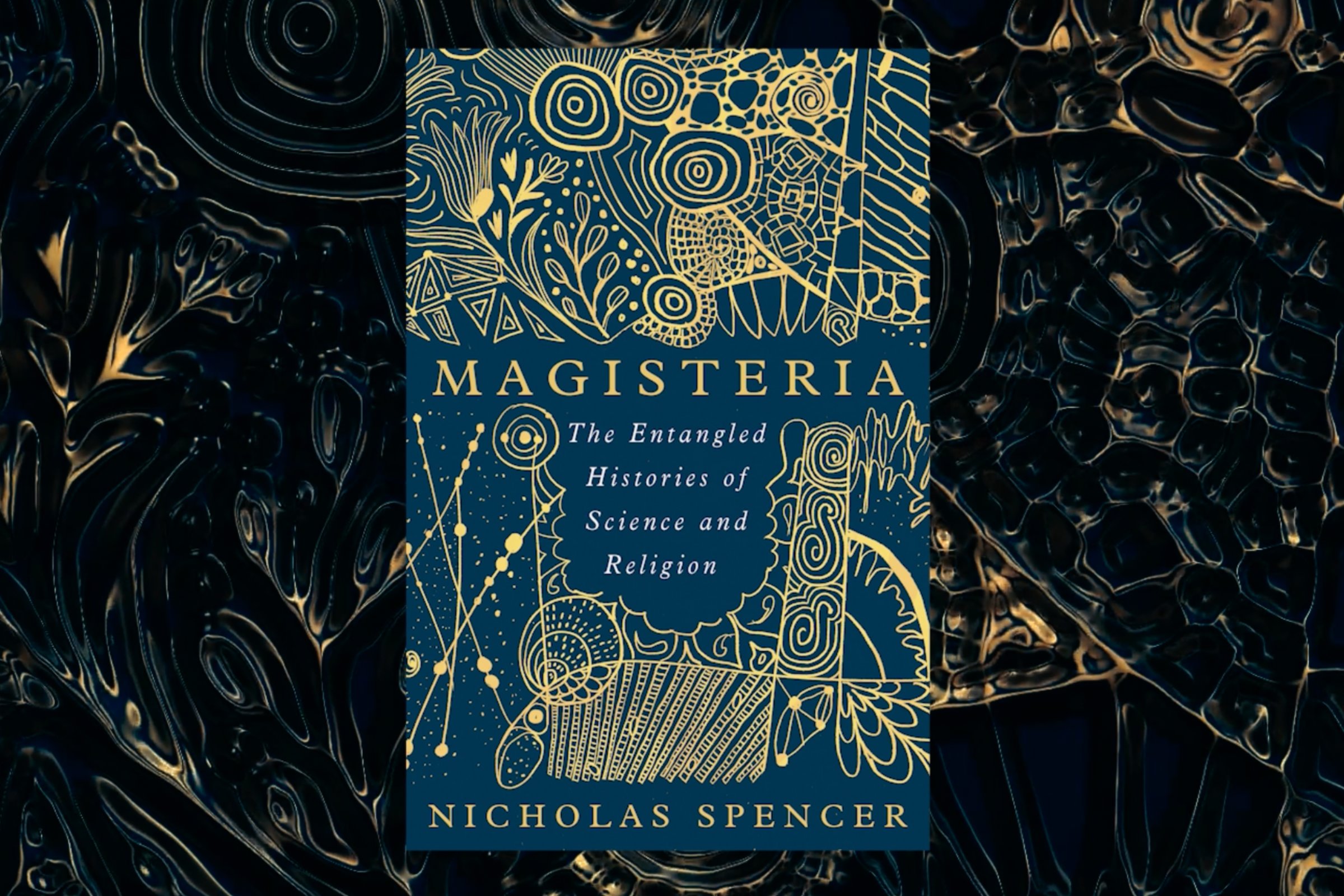
Magisteria
Attempts to ‘tidy up’ the relationship between science and religion, either the historical relationship or any normative understanding of their interaction, are, it seems, doomed to failure.
The two have been shackled together by dint of a powerful but ill-fitting metaphor for about 150 years, since the chemist and would-be intellectual historian John Draper helped reify the disciplines and their alleged relationship in his book History of the Conflict between Religion and Science. His idea that the two entities were in fundamental conflict was true enough to be believable, at least in the atmosphere of the later nineteenth century, if not true enough to be actually true. The metaphor stuck.
Attempts to revise this model have been underway since the history of science and religion became its own academic discipline, and many scholars (not least some associated with this network) have done a great deal to show the poverty and partiality of Draper’s thesis.
Their efforts have, I fear, had limited effect, at least outside the academy. According to research by Theos/ YouGov, more people in Britain disagree that “Christianity played an important part of the rise of science” than agree (29% vs 24%; the rest don’t know/ don’t care), while twice as many UK adults think science and religion are incompatible rather than compatible. The idea that “religion” retarded science, and competes with it still, remains strong.
The problem is that what the conflict metaphor loses in evidential weakness it gains in rhetorical strength. Alternatives are not really alternatives. John Hedley Brooke’s so-called complexity thesis is not, as Brooke himself has pointed out, a thesis at all; just a statement of historical reality. In the words of Ronald Numbers, “Brooke’s complexifying history seems to have little to recommend it besides its truth,” and mere truth in matters of public opinion is rarely enough.
Numbers himself has put forward some “mid-scale patterns” for the relationship – naturalization, privatization, secularization, globalization, and radicalization – that try to bring some order to the chaos, without “abandoning the gospel of complexity.” In the same volume, a kind of festschrift to Brooke, Peter Harrison’s put forward a metaphor of territories, which has great strength and potential, despite being predicated on the disconcerting observation that science and religion have not, for most of their history, been the kind of things that can be meaningfully compared in the first place.
Yet, the only metaphor to have come close to reaching the public mind with the power of Draper’s ‘conflict’ thesis, is Stephen Jay Gould’s idea, borrowed from Catholic thought, that each of science and religion is its own a magisterium, or authoritative body of teaching, and that neither of them overlaps with the other.
There are many, well-rehearsed problems with this metaphor but we should give credit where it is due. Coming in the noisy context when combative neo-Darwinians squared up against newly-confident creationists, each (over-)claiming explanatory power for themselves, Gould’s was an admirable call to lay down a few arms.
Moreover, it had merits beyond simply being peaceable. Religious thought does not, as a rule, have anything helpful to say about the structure of the atom, the layout of the periodic table, or the theory of relativity (as Einstein once told a bemused Archbishop of Canterbury). In a similar vein, those scientists who think that can adjudicate authoritatively on the meaning of the parable of the Good Samaritan, the place of the Latin Mass, or even on the existence of God are, I would humbly suggest, taking their tools outside their trade. The idea of different magisteria has something going for it.
Yet the curse of the tidy metaphor remains strong because the clear fact-value distinction on which Gould’s model of Non-Overlapping Magisteria rests is ultimately untenable – at least if we want to use words to describe the world and, especially, ourselves.
Aficionados of the American series The Simpsons (is this the first ISSR blog to mention them?) will know Moe Syzlack, the emotionally-broken, aggressive, cantankerous barkeep who is never far from the centre of violent riot. In one episode, amidst one such riot, he hangs his head in shame and laments, “We’ve given the word mob a bad name.” It is a typically clever observation that naming things is not always a question of recognising a pre-existing fact or thing and then sticking on a value-neutral label. Rather, naming is the business of establishing and assigning a value-laden classification by means of which we can identify the thing and place it in a wider context. Speech is often an act, and acts are rarely neutral. In effect, the fact/ value distinction doesn’t quite work. You can’t keep the two magisteria entirely separate, in particular when it comes to human beings.
So it is that, when writing a new ‘popular’ history of science and religion that sought (once again) to dispelled Draper’s conflict, while trying to pay due respect to the true “complexity” of the historical data, it seemed to me best to appropriate Gould’s helpful metaphor without also taking on his accompanying idea of complete separation.
Indeed, the relationship between two looked a bit like Darwin’s famous “entangled bank”. Time and again, science and religion (the anachronistic terms will have to do for now) did meet and conversed (sometimes harmoniously, sometimes in tension), and perhaps most commonly it was over the nature and status of the human, and the attendant questions of who could pronounce on the issue, and how authoritatively.
Thus, when the Church Fathers came into conflict with astrology (at the time, of course a serious science) in the early Christian centuries, it was primarily over the latter’s implicit denial of human freedom, with the consequences this had for morality, and the need and possibility of salvation. It was a similar question when anatomists first described in detail the similarity between the human form and that of the (other) primates in the late seventeenth century. It was the same when the more adventurous French philosophes took the logic of Descartes bête-machine and applied it to ourselves, resulting in Julien Offray de La Mettrie’s L’homme machine in the mid-eighteenth. It was the same when early nineteenth century phrenologists (again, a serious and popular science in its day) read human character off the skull and so determined human destiny. And when Wilberforce and Huxley clashed in Oxford in 1860 (as the recently discovered near-full transcript shows). And when early twentieth zoologists put Ota Benga, a 23-year-old Congolese pygmy, on public display in the monkey house, as an example of the so-called missing link. Time and again, religion and science met and entangled over the question of the human.
In each of these cases the religious squealed. La Mettrie was condemned and ran out of town. Wilberforce’s arguments were shown to be fallacious within a decade. But sometimes their squealing was wholly legitimate. Evangelicals pamphletted their hearts out against phrenologist George Combe’s Constitution of Man, perhaps the most popular scientific book of the nineteenth, and entirely wrong. And when the Rev. James H. Gordon of the Colored Baptists Ministers’ Conference complained vociferously about Benga’s humiliation that “our race…is depressed enough, without exhibiting one of us with the apes,” and insisting “we think we are worthy of being considered human beings, with souls”, he was speaking on the right side of history.
So, ‘magisteria’ might just do the trick in terms of bringing a little clarity to the relationship between science and religion, but not non-overlapping magisteria. They different human enterprises but not entirely discrete; overlapping and entangled, in many ways that I have not touched on in this piece, but supremely over the endlessly fascinating and ultimately unfathomable question of who do we think we are we.
Nick Spencer is Senior Fellow at Theos
Magisteria: the entangled histories of science and religion is published by Oneworld