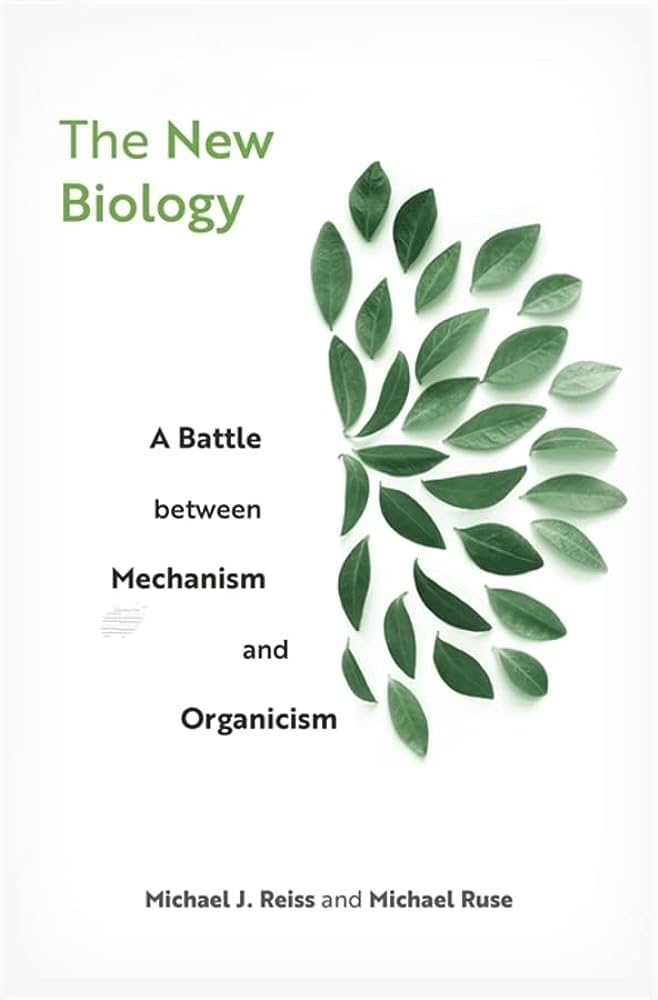
The Battle between Mechanism and Organicism in Biology
Michael J. Reiss and Michael Ruse
The Scientific Revolution, which we can conveniently bracket as lasting from Copernicus to Newton, was above all a change in what linguists call ‘root metaphors’, from seeing the world as an organism – organicism – to seeing the world as a machine – mechanism. To use other language, science pre-Revolution demanded that one think of entities as functioning wholes, ‘holism’; science post-Revolution worked by looking at entities as composed of individual parts, ‘reductionism’. However, the flies in the mechanistic ointment are living organisms. They seem too intricately constructed for many to think that they could be the product of the blind laws we associate with machines.
People worried about this problem from the time of Robert Boyle to Charles Darwin, who claimed that through his mechanism of natural selection we can explain changes in organisms over time using only natural laws. Not all were convinced and until the end of the nineteenth century there were many, professional biologists as well as laypeople, who thought that a return to the old metaphor of the organism was necessary. In the first half of the twentieth century, thanks to advances in the study of heredity, culminating in the discovery of the structure of the genetic material, DNA, in 1953, to many mechanism was all triumphant.
It turned out, however, that it was too soon to write obituaries for organicism. It is true that understanding the way in which DNA functions demanded one think in terms of its parts; but, many phenomena, most particularly the growth and development of organisms, seemed still to demand a more integrated understanding. Today there is a lively, often bitter, divide among biologists over this division. It is the aim of our book The New Biology: A Battle between Mechanism and Organicism published by Harvard University Press on 20 June 2023, to throw light on the controversy.
In this book we discuss such terms as mechanism, reductionism, organicism, and holism. We explore the broader significance of these developments in biology, including their philosophical, educational, religious, and policy relevance. We examine the on-going debate between mechanism/reductionism and organicism/holism and ask whether we are simply witnessing something of a corrective to an historical anomaly in the history of biology, returning now to a more balanced vision of the discipline in which reductionism and holism both play complementary roles, or if we are at the beginning of the emergence of a ‘new biology’, in which a unified, holistic understanding of biology will hold sway.
A variety of developments have contributed to recent moves in biology away from the reductionism that sometimes accompanies molecular biology, cell biology and genetics. One such development has been contemporary understandings of inheritance which, rather than simply explaining the appearance of organisms, their phenotypes, in terms of their genes, recognize that genes themselves interact and are sensitive to triggers from the environment that can switch them on or off. The interface between evolutionary and developmental biology (‘Evo-Devo’) has perhaps been at the epicenter of the new biology (sticking with this term for the moment), but there are other important developments too. Ecology recognizes the significance for each species of its interactions with other species. More generally, systems biology – meaning that the level of analysis is the system as a whole (e.g., an entire cell or an ecosystem) rather than focusing only on its separated components – recognizes that there are many biological phenomena that cannot be adequately understood in terms of reductionist explanations, and is developing mathematical modeling in attempts to capture the complex processes involved. Then there is work on neural plasticity which recognizes that, in addition to structure determining function, it is also possible for function to influence structure.
These are no longer points of deep controversy within the academic biology community. Although, of course, there are localized areas of dispute, as with any science in the process of developing new knowledge, by and large, these points are widely accepted, and are guiding current research. A new more systemic, organismal biology is gaining ground. However, controversy remains within academic biology and outside of academia, the debate between mechanism/reductionism and organicism/holism is as raucous as it ever was.
Interestingly, there has been significant debate about the workings of the main, Darwinian mechanism of evolution: natural selection. Most of today’s evolutionists think that selection works exclusively or primarily at the level of the individual and their genes. But there has always been a significant minority who claimed that selection can work at the level of the group and it is because of this, and only because of this, that we can get genuine altruism, particularly among humans. David Sloan Wilson has been a pioneer in this respect, joined for the past twenty years by the philosopher Elliott Sober. Ironically, when the definitive work on the evolution of social behavior, Sociobiology: The New Synthesis (1975) by Edward O. Wilson, first appeared, the critics (notably Lewontin and Gould) accused him of being ultra-reductionistic. However, in the years before his death, E. O. Wilson came out emphatically for a group selection approach to evolution.
Inheritance segues into the topic of development. From the time of Aristotle, the remarkable phenomenon of development has lent itself to emergent interpretations, as a whole organism apparently miraculously (or ‘bewitchingly’) emerges from seemingly undifferentiated matter. The Naturphilosophen (the German Romantics) were particularly interested in this, and embryology became a science of great significance. In the twentieth century, with the coming of genetics, development rather fell by the wayside as organisms were treated something like sausage machines – genes and raw materials in at one end, organisms emerging at the other end. However, some pushed the significance of embryology in a major way, linking it to a more organicist view of life.
Then came the full-flowering of molecular biology with its major insights into the functioning of genes – from DNA to RNA to amino acids to proteins, and so on up the chain. Advances in techniques used in molecular and cell biology, such as proteomics (in which increasingly automated approaches are used to study the entire set of proteins produced by a cell or other system), and bioinformatics and computational biology (where software is used to try to make sense of the vast amount of biological information that is increasingly available about organisms), gave added impetus to the hope that by studying the constituents of organisms in more detail we would be able to understand them.
However, it soon became obvious – and if it was not obvious then major projects like the Human Genome Project made it so – that growth is a matter of organization as much as materials, and an emergentist approach was nigh mandatory. More generally, perspectives tied this thinking to emergentist areas elsewhere in science. In this sense, the move away from ‘pure reductionism’ to a more complex view can be considered to have been, at least for some scientists, a pragmatic response to new data rather than an ideological rejection of the principles of reductionism. The discovery as a result of the Human Genome Project that humans have only about 20,000-25,000 genes that code for proteins rather than the substantially larger number that had been expected played an important part in damping the enthusiastic presumption that once we knew all about the constituents of cells, predicting everything about organisms would flow naturally.
Ecology and environmental issues generally have always attracted those with emergentist leanings. This is hardly surprising because ecology does push one towards thinking at the macro, even the mega, level. In addition, historical factors are significant for understanding the present-day distribution of organisms. On the one hand, much ecological thinking has been rooted in the ‘balance of nature’ doctrine. Although this had pagan origins, it was taken over by Christian thinkers and pushed people to think holistically. Interestingly and perhaps significantly, Darwin was always cautious about such a balance – it could happen but not necessarily. On the other hand, Herbert Spencer did see things holistically. Many think that Spencer was the ultimate reductionist, with his coining of the phrase ‘the survival of the fittest’ after he had read Darwin’s On the Origin of Species. However, this is not the case. His writings on the state as an organism were very influential, especially with the Harvard holists and then later, as the University of Chicago grew and flourished. It was not by chance that Chicago (and other places like Nebraska) became important in the new science of ecology, situated as they were in the Midwest, where environmental change (e.g., the Dust Bowl) was so significant.
Later ecological thinkers, much influenced by G. Evelyn Hutchinson, were more inclined to mechanistic thinking – work on feedback systems in the Second World War was significant here – but some of Hutchinson’s most important followers, notably the Odum brothers, were very inclined to holistic thinking. In many cases, this subsequently connected to a sympathy for the brainchild of the English scientist James Lovelock, the Gaia hypothesis, the idea of the Earth as an organism. It is noteworthy that Lovelock’s great supporter, Lynn Margulis, was always deeply committed to symbiosis. It is also noteworthy that the Gaia hypothesis is disliked both by scientists such as Richard Dawkins, who think it insufficiently reductionistic, and by Evangelical Christians, who think it deifies the Creation.
The philosophical issues surrounding holistic biology are more subtle than is sometimes appreciated. At the very least, the new more organismal biology seems to move away from a mode of explanation that assumes that higher level phenomena can be explained entirely in terms of lower level ones. Instead, it moves towards a recognition (i) of the reality and importance of ‘emergence’ (that phenomena that are genuinely new can be seen at higher levels, follow their own laws and cannot be explained entirely in terms of lower level phenomena), and (ii) that biological explanations often need to be systemic, and to take into account the possibility that lower-level phenomena can be influenced by higher-level organismal factors and by functional context.
There are also issues about determinism to be explored. Epigenetics and other features of contemporary genetics mark a move away from a simplistic genetic determinism in which it is presumed that the phenotype simply follows from the genotype. Of course, that kind of genetic determinism never received much scientific support, existing more in the media rhetoric of a ‘gene for’ this or that, but it nonetheless has had and continues to have a powerful role in the popular (public and school) understanding of biology. One issue to be debated is whether or not holistic biology, with its complex interactionist assumptions, is deterministic and, if so, in what way(s). We therefore explore whether we are dealing with a complex, interactive form of determinism, or whether holistic biology cannot properly be said to be determinist at all. As with chaos theory, it does not entirely settle the matter that complex systems can be modeled mathematically in a way that makes deterministic assumptions. Both determinism and indeterminism are metaphysical conjectures that become more or less reasonable in the light of a complex network of scientific and philosophical considerations.
We believe that the developments in biology with which our book is concerned have implications for theology and religious belief. The strong reductionism of molecular biology has, in some people’s minds, fostered the idea that modern scientific biology is incompatible with religious faith. While that was never a view that stood up to critical examination, work by sociologists shows it is quite widely accepted, particularly among atheists. The move away from strong reductionism in biology promises to remove what has been, for some people, an obstacle to religious faith, or at best something that sits uneasily with it. There has been fruitful engagement between theology and emergentism. We see similar scope for theology to engage with the current trend towards holistic biology. There are also constructive theological implications of the new biology. The systemic complexity of the new biology points to the inter-connectedness of creation in a way that finds a parallel in the religious vision of the unity of all things in God.
Issues about reductionism have been at the heart of work on the interface between science and theology. Philosophical reconciliations have been proposed, including the non-reductive physicalism of Warren Brown, Nancey Murphy and colleagues, the emergentism of Philip Clayton, and elsewhere. These philosophical proposals have been helpful, but we think that they can be strengthened by the scientific developments that we discuss in our book. It is arguable that in the new more organismal biology, science is rescuing itself from the strong reductionist assumptions that have sat uneasily with religious faith. We consider that recent developments in biology make it easier to argue that today’s biology is compatible with a theistic faith.
There is a degree of convergence to be explored between the sense of the inter-dependence within nature that emerges from the new biology, the mystical vision of the unity of all things, and the Christian conviction that all things cohere in Christ. This is an approach with a long history, one reflected in fiction and the visual arts (William Blake, Samuel Palmer, Samuel Taylor Coleridge, David Jones and others) as well as in theology. The ‘new biology’ also adds weight to the point often made by Arthur Peacocke, that there is ‘top-down’ causation as well as ‘bottom-up’ causation, and that wholes influence parts as well as parts giving rise to wholes. This approach leaves scope for multiple influences of different kinds.