A Landscape of Consciousness
Robert Lawrence Kuhn
“Explanations of consciousness abound and the radical diversity of theories is telling. Explanations, or theories, are said to work at astonishingly divergent orders of magnitude and putative realms of reality.”
That’s how I begin “A Landscape of Consciousness: Toward a “Taxonomy of Explanations and Implications” [“Landscape”] — my review of theories of consciousness published in Progress in Biophysics and Molecular Biology (Volume 190, August 2024, Pages 28-169). The print PDF can be viewed or downloaded on the ScienceDirect page, upper left, Open Access — though online easier to read and navigate.
Landscape is the product of a lifetime. My PhD was in neurophysiology at UCLA’s Brain Research Institute (1968). I am creator and host of Closer To Truth, the long-running (25 years) public television series and web resource on science and philosophy, roughly one-third of which focuses on mind/brain topics. I have discussed consciousness with over 200 scientists and philosophers (Closer To Truth website and Closer To Truth YouTube channel).
I use these Closer To Truth discussions as resources for Landscape. I want to give feel and flavor, as well as proposition and argument, for the astoundingly diverse attitudes and approaches to consciousness coming from radically diverse perspectives and worldviews. That’s why I use spontaneous quotes from verbal conversations along with meticulous quotes from scholarly papers.
In Landscape, I present diverse theories of consciousness from materialist/physicalist to nonmaterialist/nonphysicalist. Categories: Materialism Theories (philosophical, neurobiological, electromagnetic field, computational and informational, homeostatic and affective, embodied and enactive, relational, representational, language, phylogenetic evolution); Non-Reductive Physicalism; Quantum Theories; Integrated Information Theory; Panpsychisms; Monisms; Dualisms; Idealisms; Anomalous and Altered States Theories; Challenge Theories. There are many subcategories, especially for Materialism Theories. (Figures 2 and 3, following.) Each explanation is self- described by its adherents, critique is minimal and only for clarification, and there is no attempt to adjudicate among theories.
I seek an organizing framework for these diverse theories of consciousness and to explore their impact on “ultimate questions.” I have two central theses: (i) understanding consciousness at this point cannot be limited to selected ways of thinking or knowing, but should seek expansive yet rational diversity, and (ii) ultimate questions related to consciousness, such as meaning/purpose/value (if any), AI consciousness, virtual immortality, survival beyond death, also free will, etc., cannot be understood except in the light of particular theories of consciousness.
Here’s the backstory. The journal, Progress in Biophysics and Molecular Biology [PBMB], invited me to write an article on consciousness broadly. (I was reluctant, imagining what it would entail — even so, I wildly underestimated.) In my first draft, I included, along with all the hard science, philosophical and theological explanations: complex philosophical theories (e.g., non-reductive physicalism, emergent dualism, panprotopsychism) and diverse religious theories (i.e., Hindu, Buddhist, Daoist, Judaic, Christian, Islamic and Indigenous) — all with a similar degree of specificity and seriousness as for each of the myriad materialist/physicalist theories. The anonymous peer reviewer, while generously appreciative of the scientific theories (and offering helpful suggestions), recommended dropping the purely philosophical and theological theories — which, he said, journal readers would not much care about. I responded by agreeing that journal readers would likely not care, but that I surely did care, and because I was going to do this Landscape once in my life, I must make it as complete as I, in my idiosyncratic way, saw fit. Moreover, if PBMB did not want to publish it with all the theories, I’d totally understand and seek another venue. To PBMB’s credit, they agreed to publish it all, nothing cut, nothing truncated.
I note in Landscape that my purpose must be humble: collect and categorize, not assess and adjudicate. Seek insights, not answers. Unrealistically, I’d like to get all the theories, at least all contemporary theories that are sufficiently distinct with explanations that can surmount an arbitrary hurdle of rationality or conceivability. Falsification or verification is not on the agenda. I’m less concerned about the ontological truth of explanations/theories than in identifying them and then locating them on a “Landscape” (“A” Landscape, not “The” Landscape) to enable categorization and assess relationships. Thus, Landscape is not about how consciousness is measured or evolved or even how it works, but about what consciousness is and what difference it makes.
It begins as the classic “mind-body problem:” How do the felt experiences in our minds relate to the neural processes in our brains? How do mental states, whether sensory, cognitive, emotional, or even noumenal (self-less) awareness, correlate with brain states? Although there are families of mind-body problems, I focus tightly on phenomenal consciousness: our inner awareness, “what it feels like to be” something. I avoid areas adjacent to phenomenal consciousness: perception, cognition, emotion (per se), subconscious, Self, decision making, etc. — each of which is a philosophical-scientific jungle of its own. Because Landscape is structured by theories of consciousness, not by philosophical questions, each theory sets its own agenda for dealing with phenomenal consciousness.
The Landscape explanations or theories that I want to draw are as broad as possible, including those that cannot be subsumed by, and possibly not even accessed by, the scientific method. This freedom from constraint, as it were, is no excuse for wooly thinking. Standards of rationality and clarity of argument must be maintained even more tenaciously, and bases of beliefs must be specified even more clearly.
Theories overlap; some work together. Moreover, while a real-world “landscape of consciousness,” even simplified, would be drawn with three dimensions (at least), with multiple kinds and levels of nestings — a combinatorial explosion (and likely no closer to truth) — I satisfice with a one-dimensional toy-model. I array all the theories on a linear spectrum, simplistically and roughly, from the “most physical” on the left (at the beginning) to the “least physical” on the right (near the end). (I have two final categories after this spectrum.) Figures 2 and 3 provide an overall outline of Landscape (below). Note: Figure 2 has five pages; click arrows at bottom left.
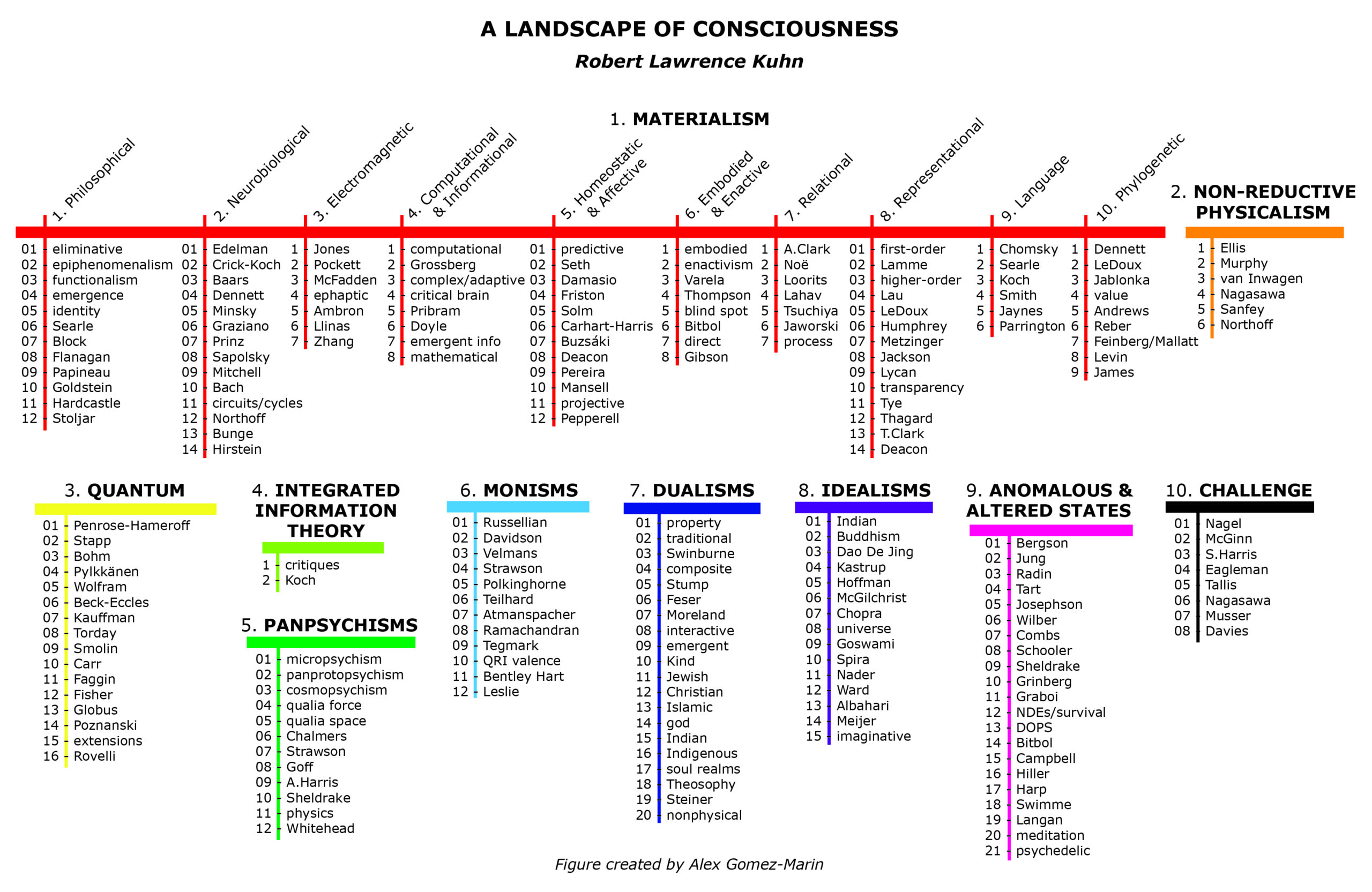
The physicalism assumed in Materialism Theories of consciousness is characterized by naturalistic, science-based perspectives, while non-materialism theories have various degrees of nonphysical perspectives outside the ambit of current science, and, as noted, in some cases not subject to the scientific method of experimentation and replicability.
Please do not assume that in Landscape the relative importance of a theory is proportional to the relative size of its description. Shorter can be stronger. It sometimes takes more words to describe lesser-known theories. For each description I feel the tension between conciseness and completeness. Moreover, several are not complete theories in themselves but ways to think about consciousness that strike me as original and perhaps insightful.
I appreciate the many readers who have written in response to Landscape. One favorite is Alex Gomez-Marin’s comment (in his review): “When was the last time you read a piece cordially inviting philosophy, neuroscience, quantum physics, psychical research, theology, and religion to the same table?” Unexpected is Stuart Kauffman’s: “By publishing the Landscape you shall have changed it.” While I don’t know if that’s true, I do know that several observe — and not with pleasure — the proliferation, not the pruning, of theories. I’ve said about theories of consciousness something akin to what I’ve said about varieties of religion (with tongue only partially in cheek): “It’s not that we have too many; it’s that we have one too few.”
In his influential paper, “What Is It Like to Be a Bat?,” Thomas Nagel offers wisdom: “Without consciousness the mind-body problem would be much less interesting. With consciousness it seems hopeless.”
“Hopeless,” to me, is invigorating; I’m up for the “hopeless challenge.” Please take “A Landscape of Consciousness” as my personal journey of consciousness; idiosyncratic, to be sure; not all for everyone, not set in cement.
So, after more than five decades of thinking, hundreds of Closer To Truth interviews and discussion, and a consuming ~175,000 words in Landscape, what do I personally believe?
While the question is fair, I still do not like it. In my Landscape review, I did not want to defend, or even to offer, my own view because it might skew perceptions of the entire enterprise. I try to present each theory as accurately and persuasively as I could, usually with the words of its creator. However, I came to recognize that some would push for my own view and that if I didn’t say something, my not-so-veiled omission could also seem like a kind of “hidden agenda”. So, right at the very end of Landscape, I have this short paragraph:
Me, I just don’t know … My own hunch, right here, right now—if I’m coerced to disclose it and for what little it’s worth—might be something of a Dualism-Idealism mashup. (I can describe; I dare not defend.)
with this footnote
Second place might go to some form of Quantum Consciousness, triggered by writing this paper and surprising me. Third place, counterintuitively, to a kind of Eliminative Materialism/Illusionism, combined with Neurobiological and Representational Theories.
Thirty-nine words in the text, 33 in the footnote; 72 words all together — out of ~175,000. I’ve come to love the confusion, luxuriating in it — but only because I love consciousness and I do not want to limit its meaning or mechanism too soon.
Finally, as we’ve witnessed on Closer To Truth, I’ve been gratified that a passion for consciousness can bring together people from different nations, regions, religions, races, ethnicities, genders, educational levels, income levels. We human beings are all united by ultimate questions.
************************
Robert Lawrence Kuhn is the creator, executive producer, writer and host of Closer To Truth on science and philosophy (Cosmos. Life. Mind. Meaning.). Peter Getzels is co-creator, producer and director. Closer To Truth website and Closer To Truth YouTube channel (subscribers: >610,000).
A review of “A Landscape of Consciousness” by Alex Gomez-Marin is published by IAI News.tv.
************************
Figures 2 and 3 are posted as hyperlinks in this blog.