
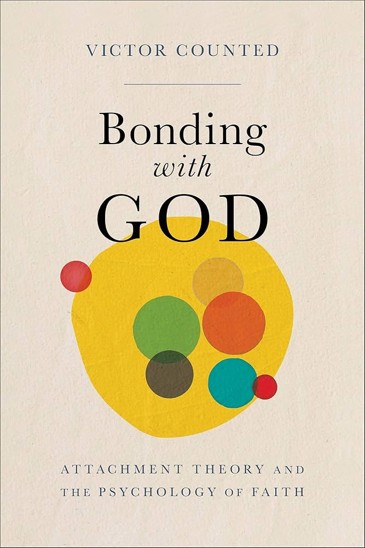
Bonding with God: Attachment Science and the Psychology of Faith
Victor Counted, PhD Associate Professor of Psychology, Regent University; Faculty Affiliate, Human Flourishing Program, Harvard University
For most of its history, the scientific study of religion has measured what people believe. Surveys ask whether respondents affirm the existence of God, how literally they read scripture, how strongly they endorse a set of doctrinal propositions. Belief, rendered as assent to content, became the unit of analysis. And yet anyone who has sat with a grieving widow who still talks to God each morning, or watched a congregation grieve with a member through illness, knows that this measurement misses something central. Faith, as it is actually lived, is far less a matter of what people hold to be true than of whom they hold onto.
This is the tension my book Bonding with God (Baker Academic, 2026) sets out to resolve. The argument in the book is straightforward and consequential: faith is better understood as a relationship than as a belief. Attachment theory, the framework John Bowlby and Mary Ainsworth developed to explain the bonds between infants and caregivers, turns out to describe the structure of religious life with unusual clarity, as I argue in the book using empirical data from hundreds of young people I studied over a decade ago during my fieldwork in Stellenbosch, South Africa. The book unpacks the nuances of religious life in the context of relationship with God.
Why the field fixed on belief
The focus on belief as a way to talk about people’s faith was not an accident. It was, sort of, inherited. When psychology became a science in the nineteenth century, it did so on foundations laid by the British associationist tradition, and that tradition bequeathed a particular picture of the mind. From Locke’s tabula rasa through Hartley’s associations and the Mills’ analysis of mental life, the mind was conceived as a fundamentally passive medium: a surface on which experience inscribed impressions, which then combined into ideas. Mental life was the having of contents.
When this empiricist psychology turned to religion, it found what its assumptions had prepared it to find. Religion appeared as a body of representations, a cluster of beliefs held in the mind, and the scientific task became one of cataloguing those contents and the mechanisms that produced them. The contemporary cognitive science of religion, for all its sophistication, is recognisably the heir of this lineage. It has given us a rich account of how the mind represents supernatural agents and why certain concepts prove memorable and transmissible. But its centre of gravity remains where associationism placed it: on religion as something the mind holds rather than something the person does.
The cost is that the relational dimensions of faith fall outside the frame. A passive mind registering representations cannot account for a believer who reaches for God in terror, who feels held or abandoned, who grieves a rupture with the divine as a loss rather than a revised opinion. These are not contents of religious cognition. As I argue in my book, Bonding with God, these are the movements of a relationship with God. To see them, the science of religion needs a model of the mind as active and relational rather than passive and representational, and that is precisely what attachment science supplies.
How do we move from belief to bond?
Attachment science was never about belief, and it never assumed a passive mind. It concerns the deep human need for a secure base from which to explore the world and a safe haven to return to when the world becomes frightening. Infants form these bonds with caregivers; adults extend them to partners, friends, and communities. The proposal at the heart of Bonding with God is that believers form them with God as well, and that the same dynamics and panoply that govern human attachment govern this one.
This is not a wholly new suggestion. Lee Kirkpatrick opened the line of inquiry more than three decades ago, asking whether bonds with God form by correspondence with early caregiving relationships or by compensation for their failures. These hypotheses have been expanded by Swedish Pehr Granqvist. That work was generative, but it largely lacked reach and rupture because the evidence remained overwhelmingly Western, and the focus stayed on the formation of the bond rather than on what happens when it breaks. The contribution of Bonding with God is to extend the relational account across cultures, to take its disruption seriously as a structured process, and to press the underlying claim further than the literature usually does, namely that the bond is not one feature of faith among others but the thing the science of religion should have been studying all along.
Consider what this reframing does. A person’s relationship with God can now be described along the same dimensions psychologists use for any close bond: the security of the attachment, the anxiety that the figure may prove unavailable, the avoidance that keeps the figure at a safe distance. These are measurable orientations that predict how people pray, how they cope with suffering, and how they relate to the communities that mediate their faith. Two people can affirm identical creeds while inhabiting entirely different relationships with the God those creeds describe, one marked by trust, the other by anxious striving or defended distance. While the belief may look the same on a survey, the believer’s bond with God does not.
What the bond explains
This reframing of faith as a relational bond explains things the belief model cannot. It explains why religious people under threat do not reason their way to comfort but seek proximity, turning toward God the way a frightened child turns toward a parent. It explains why the loss of faith so often feels less like changing one’s mind and more like the rupture of a relationship. And it explains why secure attachment to God predicts patterns of flourishing, including lower distress and greater resilience, that doctrinal commitment alone does not.
The book gives particular attention to spiritual attachment disruption. Drawing on Bowlby’s account of separation and loss in attachment relationships, I trace a protest-despair-detachment sequence in the religious life. Confronted with divine silence, unanswered suffering, or betrayal by a faith community, believers first protest, with lament and an intensified reaching for the God who seems to have withdrawn. When the rupture persists, protest gives way to despair. In another book, The Roots of Radicalization, I have explored attachment despair as the source of radicalization and fundamentalism in people of faith. And in its most costly form, despair settles into detachment, a reorganisation of the inner life around God. This is a felt shift in how God is experienced at all, as the old way of relating to God falls away. Believers going through a season of detachment often still affirm that God exists. What has broken is not the belief but the bond. A faith crisis, in other words, is frequently a crisis of attachment rather than of conviction, and responses that only correct doctrine will miss the wound entirely.
Two objections
A reasonable objection is that this framework simply reimports a Western psychological model. Bonding with God answers with breadth of evidence: the patterns it describes are consistent with findings from the Global Flourishing Study, involving more than 200k participants across 23 countries. Secure and insecure orientations toward the divine appear well beyond the WEIRD samples that have dominated the field, though the language and ritual they take vary considerably from one context to the next. I came to this view partly through life rather than data, having carried my own faith across several countries on five continents and watched it form, fracture, and reform in settings whose religious vocabularies bore little resemblance to one another.
A sharper objection, which an ISSR readership will feel first, runs the other way. If faith is an attachment bond of the kind a child forms with a parent, has the science not simply restated the old reductive charge of Feuerbach and Freud, that God is a projection of human need? The inference does not hold. Attachment science describes the form a relationship takes as the believer experiences it; it is silent on whether the figure at the other end is real. The framework that theorizes a believer’s bond with God maps equally well a child’s bond with a parent who is unmistakably present. To show that faith is relational is to describe its psychology, not to settle its truth.
Why it matters
For a community devoted to the dialogue between science and religion, the stakes here are not only empirical. I think that there is an interpretive claim here. To say that faith is a relationship rather than a belief brings the psychology of religion into unexpected proximity with how the theological traditions have described faith all along. Theologians like John Calvin and Philip Melanchthon insisted that faith is fiducia, trust in a person, before it is assensus, assent to propositions. This became standard in Reformed and Lutheran systematic theology in the works of figures like Francis Turretin and later Protestant scholastics. The belief-centred science of religion lost that distinction; a relational psychology recovered it. Grace acquires psychological texture as the experience of a secure base, the assurance that one is held prior to any performance. Doubt looks less like intellectual error and more like attachment anxiety. Lament and the sense of divine hiddenness implies a bond under strain rather than onto failures of cognition.
None of this replaces theological description. Bonding with God offers theology a second language for realities it has named for centuries, and lets science and religion illuminate the same human life from two sides rather than talk past each other. That is the invitation Bonding with God extends: to study faith as the relationship it has always been for the people who live it, and to let attachment science, rigorously applied and cross-culturally tested, show us what we have been missing.
—
Dr. Victor Counted is Associate Professor of Psychology and Director of the Office of Research and Sponsored Programs at Regent University, Virginia Beach, and a Faculty Affiliate at the Human Flourishing Program, Harvard University. He is the Associate Editor of the Journal of Positive Psychology, the author of Bonding with God: Attachment Theory and the Psychology of Faith (Baker Academic, 2026) and a researcher on the Global Flourishing Study. He lives in Virginia Beach with his wife Jessie, and two sons — Victor Jr. and Zuphland.
