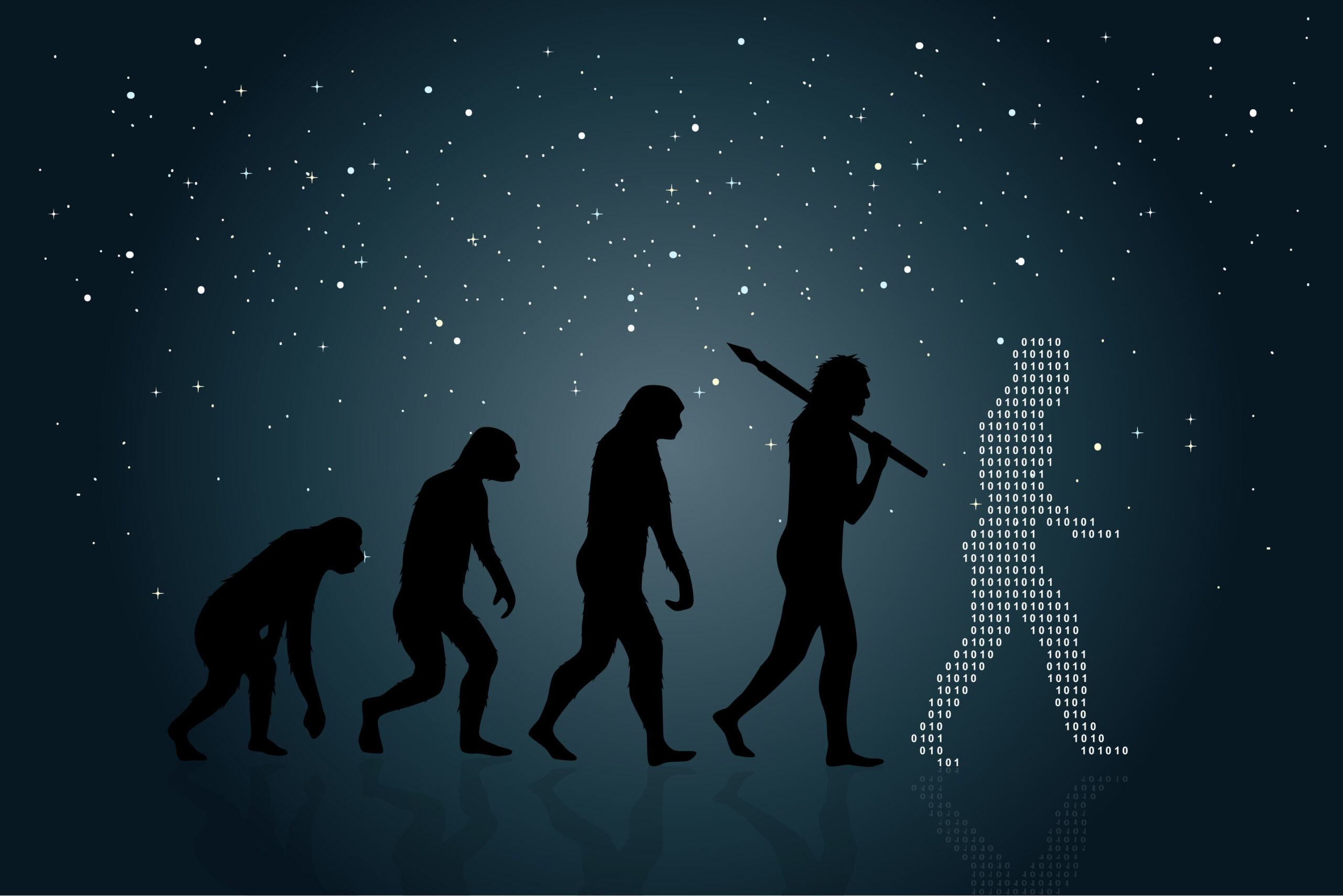
Is Artificial Intelligence Compatible with Evolution? (Part I)
Javier Sánchez-Cañizares
“Ciencia, Razón y Fe” (CRYF)
“Mind-brain” Group. Institute for Culture and Society (ICS)
University of Navarra
Introduction
“Many of us will die stroking a machine and being stroked by it.” Predictions of this caliber undoubtedly cause some inner jolt in most people. That machines appear at the end of our life does not imply in principle greater astonishment than their presence throughout the other moments of each human biography. However, the attribution of such a genuinely personal manifestation as compassion and affection —expressed through caresses— to a machine, in a moment as singular as death, raises in all its radicalism many questions on the specificity of the human being, on that of artificial devices, and on the type of relationships that may occur between the two.
We can all affirm that machines are produced to assist humans in their biological, cultural, and, why not, spiritual development. In the case of the machines that we include under the label of artificial intelligence (AI), we could add the nuance that the AI, created and developed by natural intelligence, helps the latter in carrying out a multitude of processes (productive, curative, evaluative, cognitive…) with a specific purpose. I have intentionally added the term ‘cognitive’ in the previous list because deep learning techniques can show hidden patterns in the most successful problem-solving strategies that would otherwise remain unknown to humans.
As a program, AI aims to build machines that think or act in a human or rational way. I will not dwell along these lines on the distinction between weak and strong AI, on the practical problem of how to find out with certainty that a machine is working in human mode (think of the Turing test and variants of this), or on whether it even makes sense to perform said distinction. I will rather dedicate the available space to delve into the relationship and difference between ‘natural’ and ‘artificial’ applied to intelligence; in what sense the AI program violates the very concept of AI and how a healthy relationship between human beings and AI can help the former to regain the value of nature and to recognize themselves as a mystery given to themselves.
Relationship and difference between natural and artificial
The unstoppable rise of technology makes it increasingly difficult to establish clear boundaries between what must count as natural or artificial. It seems that we can modify or ‘increase’ the natural dimension of reality almost at will, although the collateral effects can be truly worrisome. In a way, one could reason, if the human being is the fruit of nature, what the former does with the latter will also be. If the activities of natural entities, inert or living, cannot cease to be natural, why should human activities and productions cease to be?
We immediately realize that this way of posing the question hides a supposed opposition between natural and artificial as a criterion of distinction. But what is artificial is not simply opposed to what is natural. The former may determine the latter, at least in theory, more and better. This fake dialogue between God and Nietzsche that I happened to find online (but I have not been able to recover) serves as an illustration for what I mean: Nietzsche says to God: —‘I am also capable of creating man.’ God responds: —‘Go ahead.’ Nietzsche then asks God: —‘Give me a little mud.’ But God exclaims: —‘The mud is mine!’ The moral, at least for me, is that the artificial world is not created out of nothing; it is based on something already given and takes advantage of its potential to build a novelty for specific purposes.
This last idea gives us a clue to deepen the relationship and distinction between natural and artificial. Sure enough, nature is capable of novelty, as the entire evolutionary history reveals. Nature itself is creative insofar as its dynamics generate, from existing events, new possibilities that will eventually become future realities. The evolution of the universe towards greater local complexity is made possible by the extremely low initial entropy of the Big Bang, as pointed out by the Second Law of Thermodynamics. On the contrary, what does it mean to build or produce something by a human being from previous material? It means, precisely, subtracting a portion of the universe from the global directionality of evolution to dedicate it to specific purposes, which have to do with human interests or ends: from cutting down trees with power saws to all the machinery that involves animal exploitation for human consumption.
The idea that I want to emphasize is that, on the one hand, what is artificial continues to depend on what is natural. Even if only for the mere fact that today we still need to start from elementary particles —such as the initial mud— to produce whatever artifact. In this sense, what is artificial continues to participate in the mystery of the existence of nature as given. But, on the other hand, artificial systems are selected by the human being, not simply by natural selection as occurs in evolutionary dynamics. Remarkably, the term ‘natural selection’ was initially employed for the sake of its analogy with human selection when crossing species or races of animals and plants. In my opinion, there is an insurmountable gap between the two ‘selections,’ namely, human selection is always carried out for particular purposes and, therefore, is guided by concrete reasons; on the contrary, natural selection is the result of the evolutionary movement intrinsic to nature itself.
The human peculiarity in nature
The above reflections allow us, incidentally, to better understand the peculiarity of human beings and their activity in nature. What is peculiar about the human being is his or her capacity for immaterial knowledge. It is this capacity that allows for all technical developments and the entire field that we call AI too. Immaterial knowledge, which begins with abstraction, enables the focus on particular aspects and dynamics of nature to make accurate judgments –sometimes after much effort, as the vicissitudes of scientific knowledge show– about future behaviors of natural reality. The immateriality of intellectual knowledge allows us to get out of the dangerous circle of ‘trial and error’ that characterizes finally successful adaptations based on random genetic mutations. Human beings can plan the future and adapt, partially, the world around them. We can transform part of nature into smart devices that serve our needs.
One may thus say that “techné is not so much a counterpoint to nature as a vast culmination of it.” The human being is part of nature and the vertex of natural evolution. In the human being, the evolution and directionality of the universe, though depending on physics and biology, reach a new dimension thanks to the cognitive take-off that immaterial knowledge enables. In this last evolutionary step, human freedom and responsibility are crucial so that techné does not oppose nature but continues to develop and complete it. Human beings’ uniqueness is inseparable from their vocation as guardians and cultivators of said nature from which they stem (Gen 2:15).
But the human beings’ intellectual skill is neither absolute nor is it ever perfectly exercised. Humans cannot encompass, through a single intuition, the natural dynamism that remains a mystery for them. Human beings experience themselves as given, as nature. They can partially know the natural dynamics and benefit from that knowledge to improve in particular and specific directions the upshot of biological evolution. They can accelerate the growth of some branches of the tree of life. But they cannot supplant the very evolution of the universe as a whole. In other words, while the human intellect is potentially universal, its activity is intermittent, partial, and concrete.
Artificial devices, originated by human intelligence and reason, do not seem to overcome their creators’ limitations. In particular, as a realization of the exercise of human reason, AI will always be particularized and optimized for specific tasks and purposes. The human bias in AI is indelible. Each of AI’s achievements leads directly to the inference of an intelligent design and a designer, written with small letters. This kind of reflection will help us, in the second part of this entry, to correctly think about the relationships between AI and humans within the general evolutionary framework.