
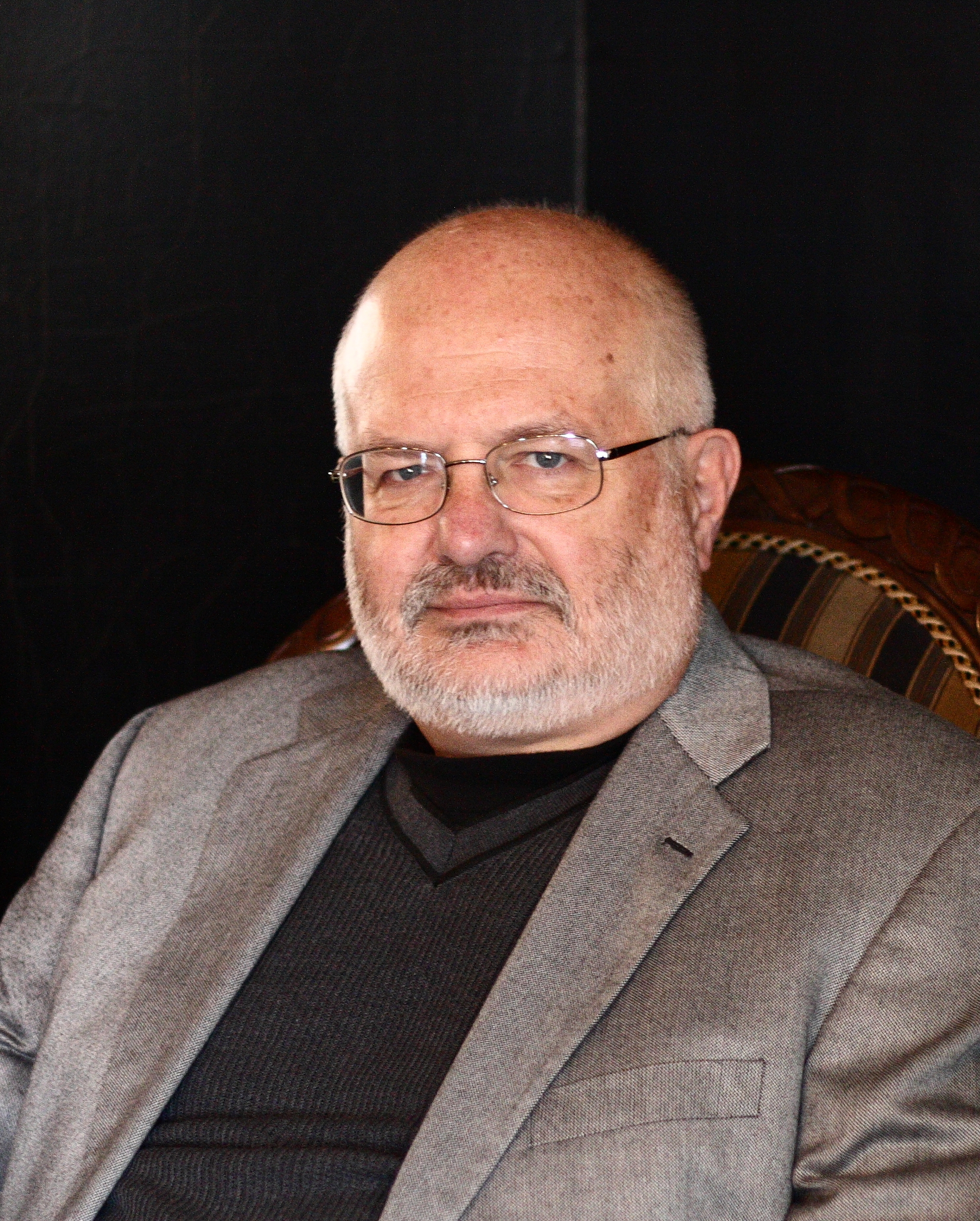
Remembering Ron Numbers
Edward J Larson and Michael Ruse
Recollections of Ron Numbers
by Edward J. Larson
I first met Ron – Professor Numbers then, of course – when I returned to the University of Wisconsin in 1982 to complete my Ph.D. in the history of science. He had been there by the mid-1970s, when I earned my M.A. in field, but I had not known of him then. After being exiled from Loma Linda College for having lost his Adventist religious faith and documenting the reasons, Ron found refuge at UW in some sort of position that eventually evolved into a chaired professorship. Ron had achieved tenure at Wisconsin by the time I met him but yet renowned. My intended major professor Bill Coleman having died, I ended up studying under Ron and he refocused my studies from the history of 19th century evolutionary thought to 20th century creationism.
I had always read the biblical accounts of creation as ancient fables that perhaps carried moral meanings but which no educated modern American could accept as literally true. Ron saw creationist accounts differently. He had taken them literally for most of his adult life and knew many educated modern Americans who still did. Those accounts shaped their current worldview. They – these people and their beliefs – served as the focus of Ron’s research at the time and he drew me into it, though I retained an intellectual detachment that lacked Ron’s empathy for the subject.
Having returned to Madison with Ron as my major professor, I took two courses from him in the history of American science. First came an undergraduate course with a graduate student component; second came a graduate seminar. At the time, many graduate students feared Ron’s rigor – so while about twenty undergraduate innocents took the first course, only a couple grad students signed up for them, with the seminar meeting over breakfast in the booth of a local diner.
Ron was a voracious and discerning reader who critically consumed virtually every scholarly book or article in his field. It showed in his teaching. He assigned a stack of photocopied articles from various scholars for the undergraduate course and a stack of leading monographs for the graduate course. Class consisted of discussing those readings.
I never knew if Ron prepared for his classes – certainly, unlike his closest friend and collaborator in the department, Dave Lindberg, Ron never lectured. If Dave’s classes were akin to a Baptist church service with polished preaching, Ron’s were like a Quaker meeting with information bubbling up from student comments facilitated by the instructor. While Dave formally tested student learning with carefully crafted written exams, Ron informally gauged it with oral student interviews. Students could write for hours in Dave’s final exams; Ron’s finals would consist of a fifteen-minute office meeting. In the end, however, Ron likely gained a better understanding than Dave of how much each student knew, and he saved time grading. I never knew which of these objectives motivated Ron.
I never equalled Ron as a critical reader of scholarship in our field and I never fully adopted his informal teaching style. His academic rigor, though, and intellectual integrity became my guiding principles. In those ways, Ron remains my mentor.
RON NUMBERS – A PERSONAL MEMOIR
by Michael Ruse
This is a very personal memoir of my dear friend Ron Numbers. It does not in any way presume to be a full and adequate obituary.
I think I first got to know Ron Numbers about thirty years ago. It could be a bit longer. One thing that made us immediate friends was a shared interest in biblical literalism, particularly as it opposed evolutionary thinking. I came by my interest almost contingently as one might say. As one born in England, I knew of the American literalists – “fundamentalists” as we used to call them — but they were entirely alien. Like men from Mars, I never encountered them. Then, going to Canada as a young man, getting interested in biology, I started to come up against the idea more and more. By the late 1970s, I was debating Creationists – particularly Henry Morris and Duane T. Gish. (I always got on much better with these people, than with the New Atheists.) This led to my being a witness for the ACLU in 1981, in a court case (in Arkansas), over whether literalism could be taught in state science classes. (The court decided it could not.)
Ron’s interest in Creationism was anything but contingent. He was born into a family of Seventh-day Adventists, and it was they basically who defined the literalist case and decided what was in and what was not. Autobiographically, he writes:
Born and reared in a fundamentalist Seventh-day Adventist family of ministers, I learned the [Adventist] version of earth history at my parents’ knees. I subsequently attended Adventist church schools from first grade through college, and although I majored in science, I saw no reason to question the claim of strict creationism. In fact I do not recall ever doubting the recent appearance of life on this earth until the late 1960s, while studying the history of science at the University of California at Berkeley.
Ron remained within the Church for many years, ending with teaching at Loma Linda University, an Adventist college in California. He managed to get himself sacked from Loma Linda and from there went to the University of Wisconsin in Madison, Wisconsin, where he stayed until the end of his life.
Why was he kicked out? Because he had presumed to write a biography of Ellen G. White, the founder of the Adventists (Prophetess of Health: Ellen G. White and the Origins of Seventh-day Adventist Health Reform). In the course of his researches, he found that Mrs White, who claimed to have all kinds of visions, had in fact pinched them from earlier sources. He included this in his book, to the huge consternation of his fellow religionists. And that was the end of Ron and the Church within he had been raised. (An absolutely fascinating account of all of this, written by Jonathan M. Butler, is given in a new interlocution to Ron’s book. It shows what an incredible man of honesty and bravery Ron Numbers truly was. I realized then and I realize now what a privilege to be able to call this man my friend.)
Moving forward rapidly, at Wisconsin Ron wrote the definitive work on the history of creationism, including a second edition where he expanded to cover the more recent Creationism-Lite, otherwise known as Intelligent Design Theory. (The Creationists: From Scientific Creationism to Intelligent Design.) Cheating somewhat, let me quote my blurb on the back of his book.
Ronald Number’s The Creationists is a modern classic. Deep sympathy combined with critical objectivity gives great insight into the thinking of those who reject evolution in favor of a narrow, literalist reading of Genesis. Now Numbers has updated his work, discussing the new approach of so-called Intelligent Design Theory and again showing how it is that so many continue to reject basic science. Ending with a frightening survey of the worldwide success of Creationism, this work is as important as it is a delight to read.
Since then, Ron kept up the work, including some very important collections. I will end this brief tribute by mentioning that, just yesterday, I was digging into one of them – Newton’s Apple and Other Myths about Science, co-edited with the only man who works as hard as Ron, Kostas Kampourakis – and discovering that I (and many others) had been wrong when we thought that Sputnik had so scared Americans that they were losing the Cold War that they poured cash into science education. Not so. They had already been starting to increase. It was the Russians, but it was their new possession of the H-bomb that scared the Americans into action. Scholars like Ron Numbers are the gift that goes on giving.
Postscript. Ron and I nearly became colleagues. In 2000 I moved from Canada to Florida State University. I was fleeing from compulsory retirement in Canada and I needed the money, because – causing the never-ending hatred of me by Human Resources – I had married one of my students. Even worse, we have been blissfully happy and have three kids and three grandchildren. In the same year, Ron was offered a job at FSU in the History Department (I was in the Philosophy Department). Ron had always had a soft spot for FSU because, after Seventh-day Adventist undergrad education, before he went to Berkeley to do his PhD, he did an MA at FSU. His first essay into the secular world, and the folk at FSU had welcomed him with sympathy and understanding. Unfortunately, Ron was then married to a biologist who would also need a job. Even more unfortunately, we then had a Dean whose way of solving problems was to do nothing, on the principle that eventually they would resolve themselves. Finally, he did offer the wife a job, but by then she was not interested and so Ron went back to Wisconsin. I regretted it very much. Every winter I would check the weather in Madison, and when it was particularly awful, I would send Ron a photo of the Ruses BBQing on their patio, in shorts and tee shirts. Whoever thought I was a nice person?!!!
