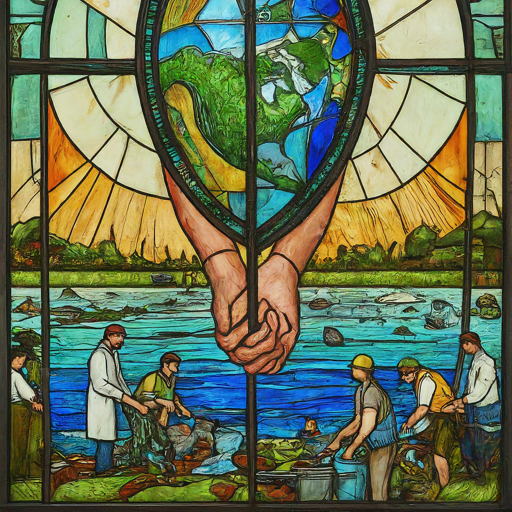
Like Oil and Water? Can Religion Cooperate with Science to Counter Adverse Global Environmental Change?
In their 2010 book, Merchants of Doubt: How a Handful of Scientists Obscured the Truth on Issues from Tobacco Smoke to Global Warming (Bloomsbury Press), historians Naomi Oreskes and Erik Conway traced the political roots of popular skepticism concerning the scientific research examining the health and safety impacts of major corporate and technological sectors. Professional science administrators and lobbyists have worked on “behalf” of capitalism, free markets, and NATO to curtail public concerns about the tobacco, nuclear, and petroleum industries. Their methods cast the scientists studying nuclear winter and changes in the atmosphere’s gaseous composition as left-wing, self-interested, economic nay-sayers. These critics assert the geophysical models underlying studies of global warming are highly uncertain or mere scare tactics intended to draw funding. The merchants of doubt court religious leadership, particularly from “Biblically-based” and right-leaning Christian organizations, via such institutional structures as foundation-funded think tanks. Several well-known American evangelists are utilizing their robust media platforms to forward climate skepticism as the Biblically justified position, giving the false impression that religious fervor and sound environmental science are incompatible.
As my 2021 text, Religion and the Environment: An Introduction (Routledge) summarizes, religion has historically promoted environmental care in urban and rural settings worldwide. While not a panacea for environmental ills, religious coda, rituals, stories, and art nurture cooperative earthkeeping and respect for other species. I have proposed that religious approaches to environmental management often have a high level of ecodimensionality, simultaneously considering multiple natural features and processes in space and time. Religiously mediated environment management systems have sometimes maintained sustainable harvests where “scientific” guidance has failed to do so – usually because the scientific advisors had an inadequate knowledge base or were incautiously attempting to maximize resource extraction. Examples include the Bali Hindu water temple system, which supports equitable distribution of irrigation water and effective applications of fallow and flooding for weed control and microbial nitrogen fixation, and the Pacific North American salmon harvest under pre-colonial First Nations management, which allowed sufficient escapement of spawning fish and ensured breeders reached the headwaters. (Bratton 2021, 30-37, 92-93)
Despite some missteps, religion and science have cooperated to generate major environmental successes. Religious imagery and values have undergirded such modern developments as the wilderness and natural ecosystem preservation movement. A quick trip the Tate Gallery in London or the National Galley in Washington will provide multiple examples of 19th-century religiously themed paintings which treasure beauty and biotic diversity in mountains, gorges, or the open seas. The conceptualizations are not just Christian, but also reflect a growing interest in Orientalism. A Fredric Edwin Church panorama of the tropics, such as El Rio De Luz (1877), and a Martin Johnson Heade depiction of blooming orchids and hummingbirds are genuinely appreciative of biological science. As environmental historian Kevin Lowe has documented in Baptized in the Soil: Christian Agrarians and the Crusade for Rural America (Oxford U. Press 2016), during the 20th century, the Christian stewardship movement supported and cooperated with the US agricultural extension agents teaching farmers the basics of scientific soil, land, and water conservation. Their efforts initiated the restoration of tens of thousands of hectares of eroded and nutrient-depleted land.
In theological terms, the contemporary religious cadres resisting climate science strongly overlap those taking anti-Darwinian stances. However, assuming the current deficits in communication and understanding between religion and the environmental sciences replicate the battles between biological evolutionary theory and creationism is too narrow an approach. All the major scientific fields have a stake in the Anthropocene. Their environmentally engaged branches incorporate specialties such as atmospheric physics, urban hydrology, and fisheries genomics. Although the concepts of evolution and deep time inform technology and economic development in myriad ways, environmental science’s outcomes are more frequently regulatory, prompting further backlash against research legitimacy. Today’s environmental conversations are pluralistic and global. All the world religions are already participating. Many indigenous and regional religions are engaged in environmental problem-solving and cultivating grassroots expertise. Liberal versus conservative collisions, especially in their more scientifically oblivious endemic American morphs, are one of many locales for action. The religious structures supporting conversations with science extend from academic eco-theology to popular framing for ideas like the Gaia hypothesis, to educational programs directing congregational sustainability initiatives.
That said, the problem of religiously justified demotion, denial, and denigration of environmental science demands even greater attention. Scientists with faith commitments have reached Evangelical Christians via accessible and theologically astute books and presentations conveying scientific perspectives on contested topics like climate change. Over the years, the Christian ethos in Loren Wilkinson’s original 1980s release of Earthkeeping: Christian Stewardship of Natural Resources (Eerdmans) has required less adjustment than the 1970s science, which, among other data deficiencies, greatly underestimated the planet’s fossil fuel reserves and the effects of industrial releases of greenhouse gases on the oceans. Staying current, ISSR Fellow Calvin DeWitt’s book Earthwise: A Guide to Helpful Creation Care (Faith Alive Christian 2011) is in its third edition. Amid her climate modeling projects and participation in international climate panels, Canadian atmospheric scientist Katharine Hayhoe has published A Climate for Change: Global Warming Facts for Faith-Based Decisions (Faithwords 2009) — coauthored with her spouse, Andrew Farley, an Evangelical church pastor. She regularly travels to deliver public presentations and speak at Christian institutions.
Unfortunately, not all Christians are cheering Hayhoe onward. On Jan. 29, 2024, I attended a Baylor University-sponsored panel discussion on “Climate Change in the 21st Century” featuring K. Hayhoe and Peter Hotez, MD, from the Baylor College of Medicine. Hotez, who is Jewish, reviewed recent climate and urbanization-initiated appearances of tropical diseases on the US Gulf Coast and in Southern Europe and described cases where the medical community has worked to overcome religious resistance to public health endeavors, such as ensuring vaccines are halal for Muslims. Both discussants reported attacks on their scientific stances identifying them by name — by members of the US Congress, TV talk shows, organizations like anti-vaccine groups, and bloggers. Both are dealing with harassing electronic communications and phone calls. A worrisome portion of this virulent opposition is tacitly faith-based.
On the positive side, religious scholars and social scientists are abandoning pat explanations and carefully examining the reasons for religious hostility or indifference to environmental science. Recent research is providing new insights into the sources of dissonance. For example, Robin Veldman’s 2019, The Gospel of Climate Skepticism: Why Evangelical Christians Oppose Action on Climate Change (U. of California Press) found that the Evangelical conceptualization of divine authority and control is a driver of Evangelical climate change skepticism. Representatives of major religions are attending international conferences on topics like climate, and faith-based environmental NGOs are becoming more common. Nonetheless, the opportunities for multi-faith or multi-sectarian conversations concerning environmental ethics and values remain limited, even in academic circles.
An additional ironic weak connection concerns the depth and breadth of the issues addressed by religious environmentalists. Many theological commentaries on “ecology” are cosmological or oriented toward “nature” in general. This top-down approach is an important form of environmental advocacy, while it is often too sweeping or eclectic to grapple with the full range of environmental science’s socially consequential findings. Religious strengths center on 1) long-established missions, such as feeding the poor, protecting rural communities, and improving agricultural production, 2) obvious health threats, like lead and pesticide poisoning (often addressed via micro mobilization of the communities at risk), and 3) high profile issues with extensive media coverage. At the annual meeting of the American Academy of Religion, the number of environmental sessions is relatively few, and most environmental science subfields have no coverage at all. Emerging pollutants and the oceans receive limited attention. Religious conversations continue to fall short of considering viable long-term solutions to the most recalcitrant problems. As the United Nations Sustainable Development goals clarify, the challenges surrounding climate are not based solely on abandoning petroleum and coal but concern replacement strategies providing inexpensive energy sources – globally and equitably. Sustainable energy has impacts, like appropriating former agricultural lands to construct solar “farms,” or altering river flows and aquatic habitats via hydroelectric dams. For example, engineers and petroleum companies have advocated pumping carbon dioxide into depleted oil wells as a means of removing carbon dioxide from the atmosphere. The method can be utilized to force the remaining petroleum from the wells. Is this ethical or not? Mining for uncommon metals and minerals utilized in manufacturing wind turbines, lighter batteries, and other sustainable technologies can disturb sacred sites and displace local communities much as coal mining and oil drilling do. From a religious perspective, are there boundaries to extraction? What may we take from and put back into the earth?
Some of the neglected topics bridge other hot-button issues, such as the potential for endocrine-disrupting pollutants to modify gender expression and sexual function in vertebrates. The concept of One Health, which considers the well-being of humans to be bound to that of other organisms and the planet, intersects major dilemmas in animal ethics. While the cutting-edge science is exciting, it can be very thick – laced with statistical risk modeling and complex biochemistry. One means for eliminating the intellectual morass generated by the merchants of doubt and least-common-denominator politics is to enhance religious engagement of “advanced” and current developments in environmental science. And conversely to discuss current religious concerns about global futures with the scientific community. Relative to atmospheric change, possible points of exchange include the impacts of alternative energy, carbon storage and sequestration, ocean warming and acidification, sea level rise, atmospheric change intensifying natural disasters (drought, wildfire, hurricanes, etc.), direct health impacts of fossil fuels, health impacts of climate change such as spread of tropical diseases, and the ever-critical investigation of sources of religious climate skepticism. Among other environmental topics worthy of greater religious attention are plastics and nanotechnology, endocrine disrupters and other pollutants modifying animal physiology, new technologies and planning strategies for urban watersheds, biodiversity and gene pool conservation, One Health, and ocean farming and productivity.
Although the ISSR has elected environmental scientists and philosophers as Fellows, to date the organization has not sponsored a major project in this tumultuous sphere. The ISSR has the potential to support scientists, such as Hayhoe and Hotez, trying to reach religious communities. The organization can act as a platform for information exchange concerning the whys of religious resistance to the environmental sciences and the best means for improving religious environmental education. The ISSR also has the institutional and scientific networks to organize conversations matching environmental scientists with expertise in fast-paced or controversial research areas with religious scholars, leaders, and social activists. A suggestion is not to repeat work already accomplished or to plan a “one-off” event, but to focus on a religion-science interface that is good match to the interests and expertise of the ISSR’s members, including those whose research is not primarily environmental, and enter an unfilled niche. Then prepare for an arduous and stimulating trek. I personally favor a series of “cutting-edge conversations” (workshops) but the Fellows may prefer other emphases. Ideas anyone?
Susan Power Bratton, PhD, is Professor Emerita in the Department of Environmental Science, Baylor University, Waco, Texas, USA. Her recent publications include research papers on the prevalence of microplastics in aquatic ecosystems, and books on religion and the environment, such as CHURCHScape: Megachurches and the Iconography of the Environment, (Waco: Baylor University Press, 2016) and The Spirit of the Appalachian Trail: Community, Environment, and Belief on a Long Distance Hiking Path (Knoxville: University of Tennessee Press, 2012 & 2015). She is currently coediting a Handbook on Religion and the Environment for Edward Elgar Publishers with Ibrahim Ozdemir, an Islamic theologian, and Stephanie Boddie, a sociologist.