WHAT IS “SPIRITUAL” IN SPIRITUAL PRACTICE? – THE EMPIRICAL QUESTION OF MEASURING WELLBEING EFFECTS PRODUCED BY SPIRITUAL PRACTICES.
Harris Wiseman
A vast amount of research suggests that spiritual practices offer a range of health and wellbeing benefits. For example, a recent systematic overview of the spiritual practices and wellbeing literature (Koburtay et al. 2022) observed that, in the workplace at least, “belongingness, connectedness, virtuous-ness, deeper meanings of existence, and self-reflexivity are important for enhancing workers’ psychological wellbeing” (pgs. 349-350), as are “prayer and reciting scripts” and the availability of spaces which allow or facilitate them (ibid.). Likewise, there is an emphasis on the moral values involved in relating spiritual practices to wellbeing. Values like “benevolence, integrity, justice, mutuality, respect, and trust are important” (ibid.) for enhancing wellbeing. Finally, “individual’s religious coping styles, belief in God, ethical practices, authenticity, justice … —as components of religiosity” (ibid.) were all deemed important for psychological wellbeing.
While there is a huge amount of correlational evidence for a relationship between spirituality and health and wellbeing, that relationship is open to many causal interpretations, which is why more experimental evidence is needed.
Going from correlation to causation raises important questions, and reveals a significant lacuna in much extant research on spiritual practices and wellbeing. How do we know that the wellbeing benefits are arising due to the “spiritual” aspects of the practice? After all, many spiritual practices can be – and have been – transposed into a secular context. They can be practised without any spiritual reference point whatsoever. Some argue that the wellbeing effects of some practices may be just down to relaxation or some other non-spiritually specific element of the practice (Benson 2001 [1975]) something like the “relaxation response” – a down-shift in the autonomic nervous system generated by numerous spiritual practices, such as yoga, tai chi and mindfulness practice.
Prima facia reductive as that proposition is (i.e., that all spiritual practices lead to wellbeing just because they are relaxing), empirical work still needs to be done disentangling the causal mechanisms relating spiritual practices to wellbeing (and to which kinds of wellbeing, more below). First of all, not all spiritual practices are relaxing or recuperative. Quite the contrary, many are demanding on various levels, emotional, physical and intellectual. Indeed, the so-called Gospel of Relaxation is a relatively recent phenomenon in the history of religion.
Moreover, since spiritual practices can be performed in a completely secular manner (see JE Brown et al.’s work comparing secular rituals at Sunday Assemblies with participants attending Christian rituals, 2021 and Charles et al. 2021; or Sarah Charles et al.’s work comparing yoga done in spiritual and secular contexts, 2022), and still have a range of wellbeing benefits, one is faced with the issue of how to tease out the benefits that potentially arise out of the specifically spiritual aspects of the practices. What is the “spiritual” in any given spiritual practice?
Spiritual practices are usually holistic phenomena in the sense that they involve situational, bodily, psychological, and social dimensions (and probably much more besides). Arguably, all of these factors interweave and dynamically co-influence each other (as Peter Wayne and Gloria Yeh et al., 2025 posit). This dynamic quality (where all the dimensions are conceived of as affecting each other through time, or forming some sort of gestalt, with some spiritual practices being more like a whole alternative space into which one enters and through which one’s being and awareness shift) raises questions for empirical measurement.
For example, if one is doing yoga or tai chi, what is it exactly that makes the difference between secular and spiritual enactment of such practices? Is there a “magic ingredient”, a discrete spiritual factor? – or, is there a range of dimensions which serve to quicken the interweaving of above-mentioned elements (posture, biochemistry, environment, conceptual scaffolding, psychology, relational factors, and so on) such that they form precisely a “spiritual” practice?
The empirical question is this: How are these specific spiritual factors to be isolated, controlled for and measured?
The question certainly matters, that is, unless one is looking at spiritual practices in the most broad-sweep and secular manner (i.e., if one does not care at all about the spiritual dimensions and is just looking to see if the practices are beneficial, generally speaking). Unless one is only interested in the benefits of spiritual practices without particular reference to their actual spiritual quality, rather than being interested in what specifically it is about the spiritual-ness of the practice that is effective, then it is essential one be able to separate these things out, control for and measure them.
Put another way, the active condition in empirical measurement must differ from the control condition precisely by removing whatever that spiritual-ness of the practice is. No easy task, if the factors involved in spiritual practices are conceived as a dynamic system, or ecology, of mutually interacting factors.
This question represents a lacuna in a great deal of extant research on spiritual practices and wellbeing. Huge amounts of the empirical research do not control for the difference between spiritual and secular enactments of a given practice, meaning that their results, though important, do not reveal what it is specifically about spirituality that leads to wellbeing benefits. ISSR seeks to fill that significant lacuna and set a precedent for future research into wellbeing and spiritual practices. The current ISSR project (part of the Templeton-funded SORSE grant), is looking to provide a level of empirical rigour and conceptual acuity that is needed for approaching this difficult question.
I will finish this brief article by remarking on the steps ISSR have been taking to bring this question into view.
First, we need a series of clear definitions of wellbeing for empirical measurement, we have selected four definitions:
- Subjective (hedonic) wellbeing. This is measured primarily in relation to life-satisfaction and the weight of positive or negative affect, commonly through PANAS (Positive and Negative Affect Schedule), which measures one’s subjective sense of wellbeing according to the following qualities: Interested, Distressed, Excited, Upset, Strong, Guilty, Scared, Hostile, Enthusiastic, Proud, Irritable, Alert, Ashamed, Inspired, Nervous, Determined, Attentive, Jittery, Active, Afraid.
- Psychological wellbeing. Carol Ryff’s (1995, 2021) conception of wellbeing arose from a sense of the limitedness of hedonic conceptions of wellbeing. There’s more to wellbeing than just “feeling good” and feeling subjectively “satisfied” in life. Ryff’s wellbeing scale includes six key indicators: positive relationships, environmental mastery, autonomy, a feeling of purpose and meaning in life, self-acceptance, and personal growth.
- Eudaimonic wellbeing. While, technically, Carol Ryff’s inventory of wellbeing was intended to measure eudaimonic wellbeing (and in much of the literature psychological and eudaimonic wellbeing are taken as synonyms), there is a compelling distinction to be drawn between purpose and control in life (which her scale predominantly measures), and more properly Aristotelian concerns (i.e., eudaimonic, concerned with character, virtue and what’s good in life). For that reason, John Groeger has advocated distinguishing between scales which measure purpose/mastery/personal growth forms of wellbeing, and scales which measure eudaimonic wellbeing proper, for which he proposes Waterman et al.’s 2010 QEWB scale.
- Spiritual wellbeing. Finally, we want to look at spiritual wellbeing specifically. The measures for this come from Ellison’s 1983 spiritual wellbeing scale (SWBS). This has various religious and existential dimensions. It centres on meaning and satisfaction in life, a sense of closeness to God, and a feeling of satisfaction in prayer and positivity about the future.
Second, we need some working definition of what the word “spiritual” actually means. We have proposed two prongs on this, a generalised account, which focuses on a definite intention to pursue a given practice with a certain seriousness of purpose, likewise, a pointedness towards some transcendent reality, with reference to some intrinsic goodness or moral quality. The other prong is to determine what exactly it is in any given practice which makes that specific practice spiritual (i.e., assaying what is spiritual about its enactment). This leads to the next point.
Third, specifying the “spiritual-ness” of a given practice is also needed so we are able to determine a meaningful control condition, a practice against which to measure potential wellbeing results arising. Put another way, generating a meaningful empirical control condition involves preserving essential features of the spiritual practice being explored while removing precisely that which is spiritual about it. To do that, we have to understand what it is that makes the active practice spiritual in the first place. Two examples will serve us.
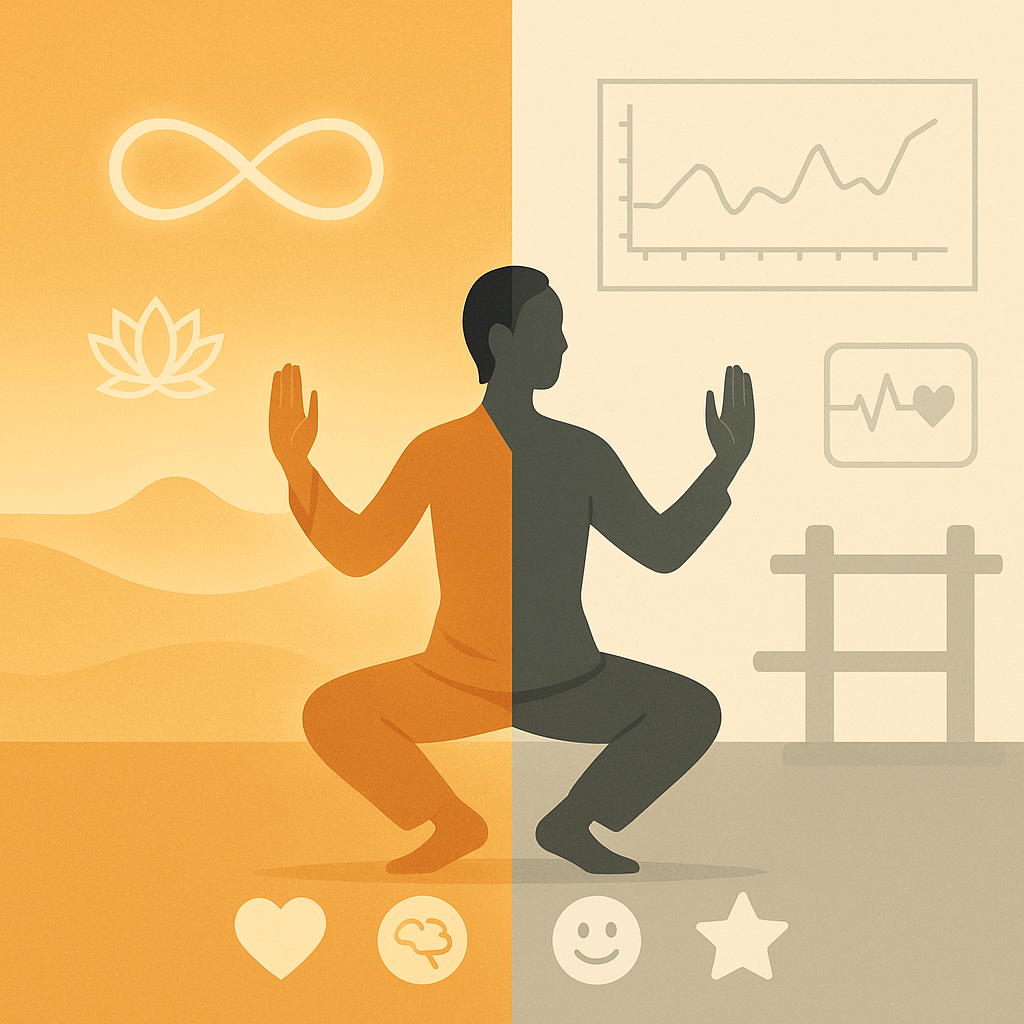
One of the practices ISSR is exploring is Qigong, characterised in a specifically Taoist context. Qigong involves coordinated breathing and movement, a specific quality of movement and intention, it is a moving meditation which embodies certain Taoist values (balance, emptiness, gentleness, mental and physical quietness), scaffolded within a conceptual framework which uses nature-based imagery rooted in the classical tradition of Taoist philosophy, for example, instructing those practising to “stand like a tree,” to make the standing stance “stable like a mountain” to let the hands flow gently and smoothly, “like water flows”, an intention towards a greater sense of connectedness with self, other, and universe, and so on. All of these elements are part of the spiritual context which can make for a spiritual Qigong practice. This contrasts with a merely secular practice of just standing, breathing and moving one’s arms about (which is certainly relaxing, and thus beneficial in a stressful world, but which has no substantive spiritual dimensions).
Thus, the control condition we propose will remove the imagery, the spiritual and philosophical explanations, the intention of connectedness, the coordination and the gentle quality (embodying the values). By just having essentially the same movements, but having subtracted the spiritual-ness of the practice, we hope to compare with greater acuity any potential wellbeing benefits that arise specifically out of the spiritual element of the Qigong practice itself.
Another practice ISSR will be looking at is the use of spiritual imagination. In keeping with our being theoretically grounded in Barnard and Teasdale’s 1991 Interacting Cognitive Subsystem model, our intention is to explore different modalities of practice, one being more propositional and conceptual in nature (in contrast to Qigong, being far quieter, and involving more focus on the body and controlled movements and breathwork). We propose that what makes spiritual imagination precisely spiritual involves a range of factors. The ambiance will be a factor with the sessions being conducted in a church setting, the specific virtues to be explored are religious values given with a religious (though not necessarily Christian) shaping, for example, thanksgiving, forgiveness, hope, and so on. The imagery and exercises will all have a definite religious colouring (for example, meditating upon and discussing a religious painting or sculpture).
Having identified the spiritual-ness of the active condition, a control condition can be more readily produced. In this case, the control condition’s point of contrast will be that it maintains the use of imagination, memory and discussion – but applies to a non-spiritual set of topics, namely, holiday destinations participants may have taken, or travel destinations they may want to take in the future. The major elements and structure of the active and control conditions will be identical (e.g., discussion of artworks and embodied exercises, the use of memory and imagination), however the setting is removed from a church hall, and any reference to spiritual virtues or anything transcendent is deliberately excised.
Put in a more theological phrasing, the core difference between the spiritual practice and the control is that the spiritual practice has two horizons, the proximate and the ultimate (i.e., God, or some larger transcendent). The particular contents being reflected upon (the spiritual virtues, which constitute the proximate horizon) are intended to lead one towards something more transcendent (the ultimate horizon). Imagination related to the virtues invites the participant to re-envisage aspects of their life. relationships and self, with respect to an ultimate horizon. In contrast, the control group has no ultimate horizon. It uses similar mechanisms and processes regarding the proximate horizon (use of memory and imagination), but does not invite the participant towards anything transcendent.
This point about the two horizons differentiates active spiritual and control conditions for both the above practices – albeit enacted in different ways, Qigong as a mind-body synchrony, a meditation-in-motion; whereas spiritual imagination is an imaginative and reflective practice. Both use their proximate contents to lead practitioners towards a more transcendent horizon. None of the controls have any such ultimate horizon.
In both these cases, the measurement process will be able to capture much more readily what we have determined to be the specifically spiritual dimensions of the practice in order to see if/what difference those spiritual aspects make to promoting wellbeing. We will then be able to see:
- if either (or both) of the spiritual practices promote some benefits leading to wellbeing;
- to what extent these benefits differ in quantity and nature, comparatively speaking;
- what kinds of wellbeing (of the four sorts) are, or are not, promoted by the practice; and finally
- we will be able to give our grounding in the Interactive Cognitive Subsystems model; that is, we will be able to make some determination of wellbeing differences arising via propositional/conceptual versus implicational meaning pathways.
There are plenty of other questions to be explored, for example, the dose and duration of the practices, the regularity of practice, the levels of engagement in practitioners, and so on. However, for the present article, I can conclude by saying: Given the above level of conceptual and empirical acuity aimed at, we contend that the ISSR approach to investigating spiritual practices and wellbeing proposes a higher-level engagement with the issue than a great deal of extant research and it fills a substantive lacuna regarding the relationship between spiritual practices and wellbeing. Our current project approach thus sets a positive and rigorous standard for future research in the academy relating wellbeing to spiritual practice.
Bibliography:
Barnard, Philip J., and John D. Teasdale. 1991. “Interacting Cognitive Subsystems: A Systemic Approach to Cognitive-Affective Interaction and Change.” Cognition and Emotion 5 (1): 1–39. doi:10.1080/02699939108411021.
Benson, Herbert (2001) [1975]. The Relaxation Response. HarperCollins.
Brown, J.E., van Mulukom, V., Charles, S.J. and Farias, M., 2021. Do you need religion to enjoy the benefits of Church services? Social bonding, morality and quality of life among religious and secular congregations. Psychology of Religion and Spirituality. 16(1):e0242546. doi: 10.1371/journal.pone.0242546. eCollection 2021.
Charles SJ, van Mulukom V, Brown JE, Watts F, Dunbar RIM, et al. (2021) United on Sunday: The effects of secular rituals on social bonding and affect. PLOS ONE 16(1): e0242546. https://doi.org/10.1371/journal.pone.0242546
Charles, S, van Mulukom, V, Saraswati, A, Watts, F, Dunbar, RIM & Farias, M 2022, ‘Bending and Bonding: A randomized controlled trial on the socio-psychobiological effects of spiritual versus secular yoga practice on social bonding’, Current Psychology, Volume 42, pages 30970–30986 https://doi.org/10.1007/s12144-022-04062-2
Ellison, CW. 1983. Spiritual wellbeing: Conceptualization and measurement. Journal of Psychology and Theology, 11 (4), pp. 330-340
Gloria Y. Yeh, Andrew Ahn, Janet Clark, Michael R. Irwin, Jian Kong, Helen Lavretsky, Fuzhong Li, Brad Manor, Wolf Mehling, Byeongsang Oh, Daniel Seitz, Ahmed Tawakol, William W.N. Tsang, Chenchen Wang, Albert Yeung, and Peter M. Wayne. 2025. The Science of Tai Chi and Qigong as Whole Person Health- Part II: Evidence Gaps and Opportunities for Future Research and Implementation. Journal of integrative and complementary medicine, 10.1089/jicm.2024.0958. Advance online publication. https://doi.org/10.1089/jicm.2024.0958
Koburtay, Tamer, Dima Jamali, Abdullah Aljafari 2023. Religion, spirituality, and wellbeing: A systematic literature review and futuristic agenda. Business Ethics, the Environment and Responsibility. Volume32, Issue1 Pages 341-357. https://doi.org/10.1111/beer.12478
PANAS Scale / Positive and Negative Affect Schedule. (2018, July 18). Retrieved June 28, 2019, from https://www.toolshero.com/psychology/personal-happiness/panas-scale/
Ryff, C. D., & Keyes, C. L. M. (1995). The structure of psychological wellbeing revisited. Journal of Personality and Social Psychology, 69(4), 719–727.
Ryff, Carol D., Jennifer Morozink Boylan, and Julie A. Kirsch, ‘Eudaimonic and Hedonic Wellbeing: An Integrative Perspective with Linkages to Sociodemographic Factors and Health’, in Matthew T. Lee, Laura D. Kubzansky, and Tyler J. VanderWeele (eds), Measuring Wellbeing: Interdisciplinary Perspectives from the Social Sciences and the Humanities (New York, 2021; online edn, Oxford Academic, 22 Apr. 2021), https://doi.org/10.1093/oso/9780197512531.003.0005,
Waterman, A. S., Schwartz, S. J., Zamboanga, B. L., Ravert, R. D., Williams, M. K., Agocha, V. B., Kim, S. Y., & Donnellan, M. B. (2010). The Questionnaire for Eudaimonic Wellbeing: Psychometric properties, demographic comparisons, and evidence of validity. The Journal of Positive Psychology, 5(1), 41–61. https://doi.org/10.1080/17439760903435208