The Science and Theology of Chanting
Fraser Watts
Scientific research on spiritual practices is very unevenly distributed. So far there has been most research on yoga and mindfulness, but relatively little on many other spiritual practices. Correcting that was the motivation behind the series of grants given by TWCF for research on the Science of Religious and Spiritual Exercises (SORSE). ISSR received one of those grants, with a particular focus on comparing practices that use human psychological resources in different ways. ISSR has also helped with the administration of another SORSE grant to Miguel Farías, From the Heart: Testing the Efficacy of Heart-Centered Contemplation.
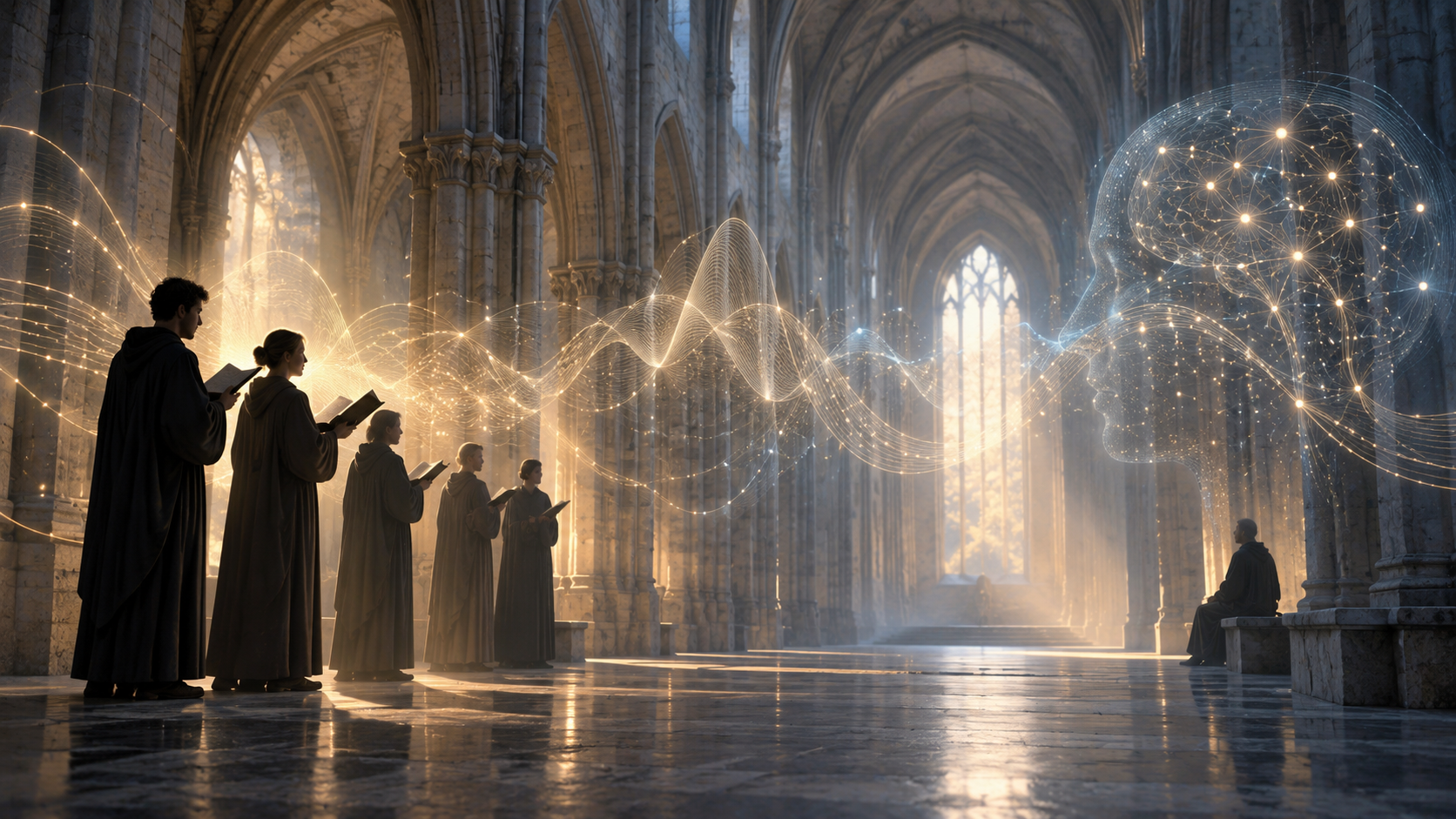
Chanting is a widely used spiritual practice, found in almost every faith tradition (e.g. Sheldrake, 2017, chapter 6). Until recently there was little research on it, though there has recently been some good neuropsychological research on chanting from Junling Gao at the Centre of Buddhist Studies in Hong Kong, and some helpful survey research and meta-analysis from Gemma Perry in Sydney. In the SORSE grant to ISSR we looked at the effects of listening to the ancient form of Christian chanting, known as Gregorian chant, or plainsong. It was been used increasingly widely in churches since it was revived in the French monastery of Solemnes in 1837. In recent decades, it has also been quite widely used for its soothing effects in a range of secular settings, including music therapy.
From a musical point of view, plainsong has some unusual characteristics, and is notable mainly for what it does not do. Most music has a regular pulse, with an emphasis either on every other note (as in a march), or every third note (as in a waltz). However, in plainsong the notes do not have a standard length, and there is no regular pulse. Most music proceeds by harmonic tension and resolution, but plainsong has no harmony. The intervals from one note to the next are generally small, and plainsong avoids doing anything to draw attention to one note rather than another. There are no surprises; so attention is stable and evenly distributed.
The effect of these distinctive musical properties is enhanced by the cultural associations of plainsong. These have been particularly discussed by the wide-ranging 20th century musicologist, Wilfred Mellers, who integrated musicology with social history. He describes plainsong as having a “spiritual rhythm” that minimises the relation to bodily movement, and is “liberative and, therefore, ecstasy inducing” (Mellers 1967, p 4). In plainsong, words are used, not as in modern music, for communication between human beings, but as invocation. “Borne on its apparently endless line, we hopefully lay aside the burden of mortality, sin and guilt, floating aloft to join the angels in the stratosphere – or at least in the vaulted roof of church or cathedral.” (Mellers 1987, p 10).
There is, indeed, an unusual relationship between words and music in plainsong. Though, for example, chants associated with the crucifixion of Jesus have an anguish about them that is very different from the joyfulness of chants celebrating the resurrection, there is no attempt to set particular words to music, as a modern song writer would do. There is an unusual organic unity between words and chant. Individual words do not attract attention, any more than do individual notes.
Plainsong, for many people, evokes a lost world of confidence in the ‘beyond’. Listening to plainsong chanting, as it wafts gently on and on, transports people to this lost world, giving them a sense of connection with the beyond, and with eternity.
Each of the “spiritual” practices we have examined in the ISSR research project has been compared with a carefully designed secular control condition. Listening to plainsong chanting in a Gothic religious building was compared with listening to wordless singing in a modern secular building (using the same participants, with the two kinds of listening in counterbalanced order). We also looked at the effects of plainsong chanting on biomarkers, but that data has not yet been analysed.
Plainsong chanting had significantly better effects on self-report measures of health, well-being and affect than listening to wordless singing. Chanting showed a clearer difference between the spiritual practice and its secular control than was found for the other two spiritual practices we examined: one involving movement and breathing, derived from Chinese internal arts; and the other involving imaginative exploration of spiritual virtues.
In our ISSR research project we have also theorised about the effects of plainsong on human attention, using Philip Barnard’s cognitive architecture, Interacting Cognitive Subsystems, also used by John Teasdale to theorise about mindfulness (Teasdale, 2022). The unusual features of plainsong chanting seem to lead to unusual stability in the distribution of attention, and to low arousal, with sustained tonal colouring rather than a sequence of expectation and resolution. The words of the chant communicate at the level of gist rather than word-for-word semantics. That leads to sustained ‘felt’ meanings in what Barnard calls ‘implicational’ cognition, rather than propositional cognition.
It is also possible to reflect theologically on the impact of chanting. Hinduism probably has a better developed theology of sound than any other faith tradition, but there are building blocks for a theology of sound in Christianity. Key elements would be that creation was ‘spoken’ into existence, that (in line with string theory) vibrations are the fundamental stuff of the universe, and that chanting connects vibrations within the human person to the vibrations that are at the heart of the universe.
Over the last few decades the gifted Christian theologian, Jeremy Begbie (dividing his time between Cambridge and Duke University) has given us a wonderfully rich theology of music. Connecting the theology of music with the scientific study of music is a potentially fruitful, and as yet under-developed, area of theology and science. Our ISSR research on chanting is making a contribution, exploring how and why chanting seems to be a particularly ‘spiritual’ kind of music.
References
Mellers, W. (1967) Caliban Reborn: Renewal in Twentieth-Century Music. Gollanz.
Mellers, W. (1987) The Masks of Orpheus: Seven Stages in the Story of Western Music. Manchester University Press.
Sheldrake, R. (2017) Science and Spiritual Practices: Reconnecting Through Direct Experience. Coronet.
Teasdale, J. (2022) What Happens in Mindfulness: Inner Awakening and Embodied Cognition. Guilford.