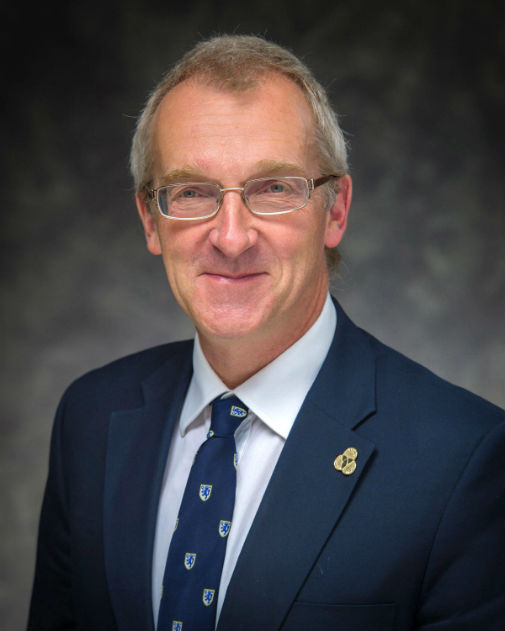
Obituary: Thomas Charles Buckland McLeish FRS, FRSC, FInstP, FISSR (1962-2023)
One of the most energetic and creative figures in the fields of both theoretical physics and science-and-religion, Prof Tom McLeish, died on the 27th February 2023. Tom’s vivacious mind, fuelled by both wonder and curiosity, defied modern disciplinary boundaries. Even his primary specialism, soft matter physics, sits at the intersection of physics, biology and chemistry— but his interests reached far wider than this. Tom’s extraordinary success in pursuing a diverse range of interests is well captured by his final job title, which he told me he could not quite believe had been permitted to choose and often delighted in sharing, ‘Chair in Natural Philosophy’ in the Department of Physics and the Centre for Medieval Studies at the University of York (2018-2022). Tom would always explain that when parsed as the ‘Love of wisdom for natural things’, natural philosophy was a fitting description of his work.
The love of wisdom for nature captures Tom attitude to science perfectly. My first encounter with Tom’s work was through his first major monograph, Faith and Wisdom in Science (Oxford University Press, 2014). In this book, Tom gave us an unforgettably creative and detailed interpretation biblical wisdom literature, most notably the book of Job, as a divine invitation to examine the natural world—the hydrological cycle, the crystallisation of snowflakes, Brownian motion, peptide molecules, and the strange behaviour of jelly. How fitting that Tom spent his final hours rereading these beloved passages with his wife of 40 years, Julie, by his side. Although I have met many scientists who are also people of faith, and who hold these two identities comfortably together, I have rarely met anyone who integrated them into a single vocation as thoroughly as Tom. For Tom, scientific work was itself deeply religious activity. This was something he learnt from his intellectual heroes, most notably Robert Grosseteste (1168-1253). The contemporary failure to recognise the culturally embedded nature of science as a creative and contemplative task, Tom argued, did not just lead to false dichotomies between science and religion, but undermined both how we teach science in schools and public trust in science more widely, both with disastrous consequences. As chair of the Royal Society’s Education Committee, Tom worked tirelessly to improve science education policy in schools across England.
Tom’s theology of science is further developed in his 2019 monograph, The Poetry and Music of Science: Comparing Creativity in Science and Art as well as his outstanding ISSR 2021 Boyle Lecture “The Rediscovery of Contemplation through Science”. The Poetry and Music of Science was the chief inspiration for a new undergraduate module I developed with a colleague on the role of imagination in science and religion, for which Tom graciously offered to make an annual guest appearance. I will always regret not taking him up on that offer at the earliest opportunity. I know from my own experience that he had a rare ability to inspire confidence and curiosity in younger scholars, empowering them follow their own passions for learning and discovery. He did this, not only simply by sharing his own infection enthusiasm, but also by truly listening to mine, with a genuine openness and concern for my success. I regularly met Tom at science and religion conferences. We usually ended up debating emergence theory, which he defended, fiercely based on his research with polymers and which I am sceptical can inform theories of consciousness or theology. I am pleased that a snapshot of these many conversations have been recorded in the edited volume Conjunctive Explanations (Routledge) published on the day he died. Even when I was still a doctoral student, just cutting my teeth in such settings, he always took my arguments seriously and for that, I will always be deeply grateful.
Tom studied his first degree and PhD in polymer physics at the University of Cambridge. In 1987, he became Lecturer in Physics at the University of Sheffield, moving to the University of Leeds in 1993 to take up the Chair in Polymer Physics. In spent ten years at Durham (2008-2018), working not only as Professor of Physics and as Pro-Vice Chancellor of Research, but also preaching as an Anglican lay reader at Durham Cathedral, as he would subsequently do at York Minister. In the same decade, Tom was elected to be a Fellow of the Royal Society, founded the ECLAS project with David Wilkinson, and was awarded The Lafranc Award for Education and Scholarship by the Archbishop of Canterbury. Despite all these accolades and commitments, I was pleasantly surprised last year when, almost thirty years after leaving the University of Leeds, Tom showed up at a small work-in-progress seminar run by the philosophers of science giving feedback on some of my work. When I remarked upon his unexpected appearance, he light-heartedly replied, “You’ll find you never really leave departments, you just collect new ones.” This small comment speaks to the vast dedication and generosity Tom had to all the many different academic and non-academic communities he participated in over his life.