The Social Brain of Religion
Miguel Farias
There is something uncanny about experimenting with people when they are performing religious actions, such as rituals. It’s not only the suspicion from the religious individuals about what we might be trying to find out about them — it’s the way in which we, experimenters, interfere with the flow of the ritual with our instruments and demands. For these, and other reasons, religious groups often refuse to take part in our studies. Sometimes, though, hard work, good networks, and fortune coincide: so we knock and doors are opened. The story I want to briefly tell here is one of a fortunate series of events.
On 8 December 2019, one of my PhD students took a flight to São Paulo. She was anxious about having her bags inspected once arriving there: she carried far too many pills for a one-week trip; 100 to be exact — 50 of them were a placebo and the other 50 were Naltrexone, a drug which blocks the action of opioids in the brain.
Six weeks earlier, I was giving a keynote presentation at a psychology of religion conference in Brazil. I presented the preliminary results of a large project which involved testing Robin Dunbar’s Social Brain theory in a religious context. In a nutshell, Dunbar’s original insight is this: living in groups is cognitively demanding and brain size, particularly the neo-frontal cortex, evolved to match the demands of our species. To keep social cohesion, we have developed a wide range of activities — from singing and dancing to religious rituals — that increase the level of social connectedness through a simple neurobiological mechanism: the release of endorphins, an endogenous opioid that is associated with relaxation and well being (also known to produce the ‘runner’s high’).
In our project, we had been studying the way in which religious rituals increase social bonding between participants and how this effect was underpinned by the release of endorphins. Because endorphins are produced in the brain and can’t be measured directly, except using an invasive type of brain scan, we tested this mechanism indirectly by comparing levels of pain tolerance before and after rituals. But ideally, I said at the end of my presentation, we would have needed to use an endorphin blocker during a ritual in a double-blind randomised study to causally test the role of endogenous opioids in producing social bonding during a ritual.
My presentation wasn’t well received. Many people in the audience frowned at the evolutionary approach of Dunbar’s theory to religion and were even less pleased about the idea of barging into rituals to take measures, or — God forbid — give drugs to people. But my bad luck came to an abrupt end when I saw a vaguely familiar face in the audience who approached me. She reminded me that some of our team had visited her religious group in São Paulo for the first part of our project; she said she was interested in having us run the double blind experiment with her Umbanda group.
Umbanda is a religion which came into existence in the early 20th century, as a blend of Roman Catholicism, African and Brazilian indigenous religions, and French Spiritualism; in Umbanda rituals trained mediums go into a trance and to channel spiritual entities who provide healing to attendants. The focus is very much on either the physical or psychological healing — the entities usually talk and provide advice, as well as laying of hands.
I knew this was a golden chance; very rarely an experimenter finds this kind of openness to conduct a somewhat invasive study. I quickly contacted my colleagues leading the project (Robin Dunbar, Fraser Watts, and Michael Reiss) and asked Sarah Charles, my PhD student working on this topic, to write the ethics application to use Naltrexone with a religious group. Good fortune smiled again when we realised that a GP could not order us such large quantity of the drug; the psychiatrist Simon Dein had recently joined our project meetings and was able to find us the amount we needed to run the experiment.
Barely 4 months before the pandemic brought international travel to a halt, Sarah landed in São Paulo. She had to get everything right in a single ritual session. Running a randomized double-blind study meant that she had to come up with a system where neither she nor the participants would know if they were taking the drug or placebo, though she would need to find out later who took what, and that the pills were randomly allocated to participants so that there was no self-selection bias. Overall, we had 24 participants, half of whom took the opioid-blocker. These people were all trained mediums, dressed in white (see photo below), and undergoing the typical ritual trance during the experiment.
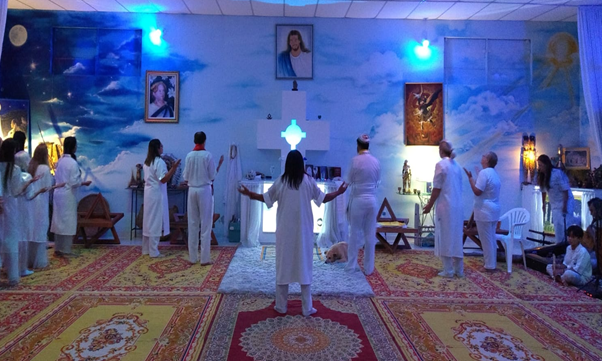
Figure 1: Photograph of a weekly ritual of the Umbanda group ‘Olhar Divino’ in São Paulo, where we carried out our experiment.
If opioids really played a crucial role in social bonding during rituals, we expected that taking Naltrexone would significantly impart the social bonding effect of the ritual, when compared with those only taking a placebo. This was what we found: when we compared the levels of social bonding before and after the rituals across the drug for those taking Naltrexone or the placebo, we saw that those taking Naltrexone had significantly lower social bonding scores after the ritual than those who took placebo (see Figure 2). The detailed published results can be read here (hyperlink to https://royalsocietypublishing.org/doi/full/10.1098/rsbl.2020.0485)
We are aware that this is only one study, which will need to be replicated and extended to understand, for example, if there are neurobiological mechanisms other than opioids that help in creating the special boding effect of rituals. But it stands as a rare experiment, one of only a handful of psychology studies that used a drug during a ritual which clearly led to an altered experience (a reduced sense of social bonding).
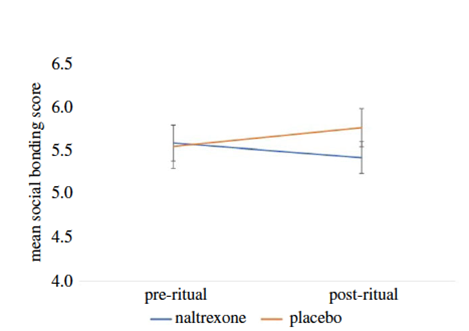
Figure 2: When compared with before the ritual, participants who took naltrexone had significantly lower social bonding scores after the ritual than those who took placebo.
Acknowledgements: This project was supported by a grant from the Templeton Religion Trust (TRT0153) to ISSR. The original proposal was written by Fraser Watts and Robin Dunbar, with the assistance of Léon Turner and Miguel Farias, and Michael Reiss led the grant. We are grateful to the many other academics who joined the project and to the hundreds of participants who kindly allowed us to disrupt their religious activities in order to take part in our studies.