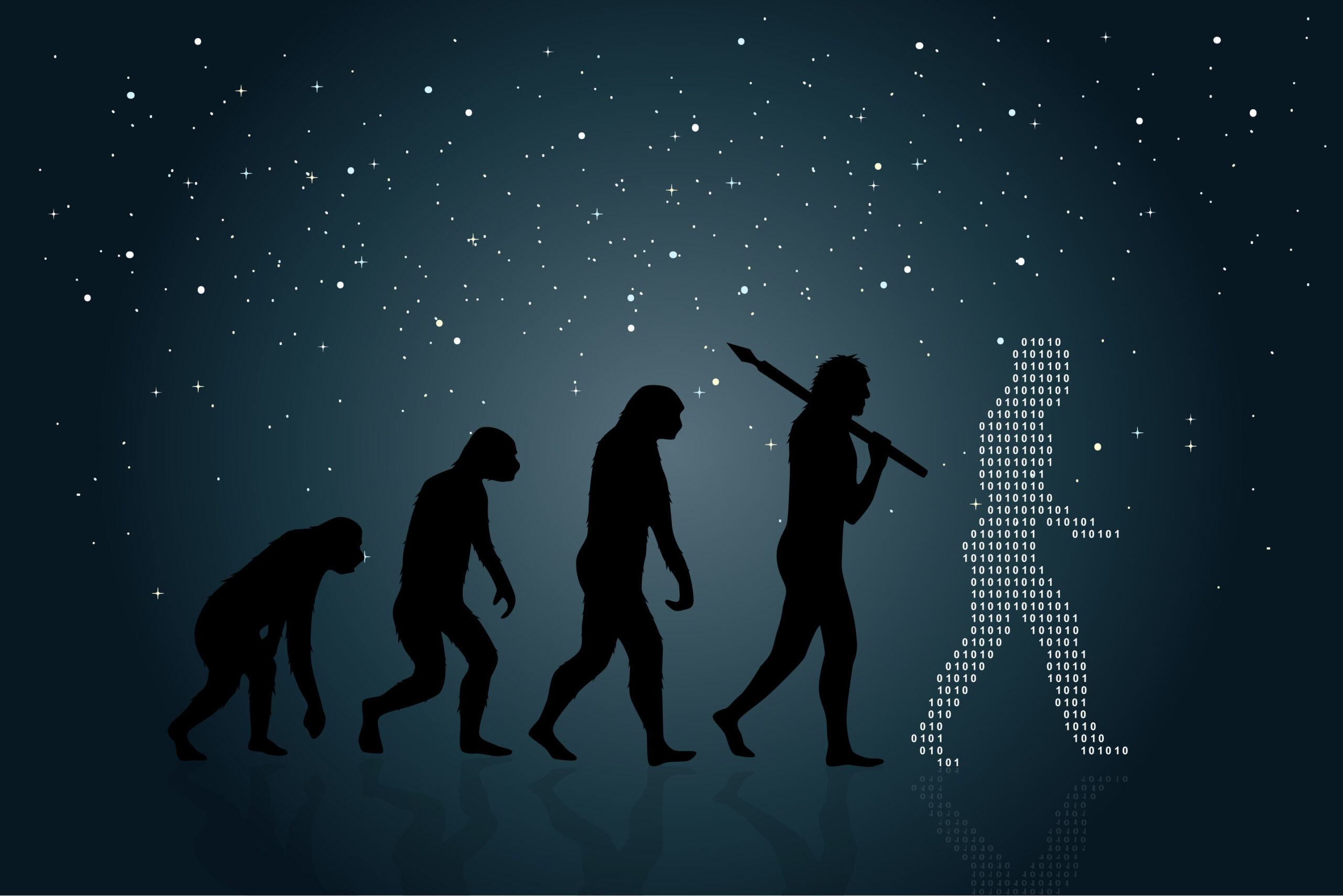
Is Artificial Intelligence Compatible with Evolution? (Part II)
Javier Sánchez-Cañizares
“Ciencia, Razón y Fe” (CRYF)
“Mind-brain” Group. Institute for Culture and Society (ICS)
University of Navarra
An artificial Evolution?
Spanish scholar Gonzalo Génova insists on a simple definition that bears on AI: machines are defined by their purposes. Their goals are always particular, imposed by human programmers to solve concrete problems. Now, this leads us directly to reflect on the appearance of ends in nature. What is an end? How should one define ends? Are they merely epistemic or do they possess an ontological entity? The question I want to raise is not simply the appearance of teleology in nature —a highly controversial question in the current philosophy of science— but whether one is entitled to think about the AI program in the following framework: regardless of our metaphysical positions concerning teleology, human beings, as a fruit of natural evolution, experience themselves with purposes; wouldn’t it be reasonable to expect that for AI devices, subjected to similar evolutionary mechanisms, other ends, perhaps different from those designed by human creators, can emerge?
One of the most promising fields in this regard is algorithmic evolution. A simple machine can be identified with the execution of a certain algorithm to obtain some result. But if we keep the outcome undefined and allow the algorithm to modify itself more or less randomly, so that outputs that the machine itself imposes when interacting with the rest of the universe are optimized, wouldn’t we be on the right track to achieve something very close to human intelligence or even superintelligence?
The problem with this way of arguing is that it asks for an explanatory power to evolution that the evolutionary theoretical framework does not possess. Trusting for an indefinite time the appearance of a novelty similar or superior to human intelligence is neither scientific nor honest; it means to carry out a vague extrapolation inspired by the general similarities that all processes have with evolution, but forgetting relevant and decisive differences. If I may digress, using as an excuse having all the time in the world available implies, on the one hand, falling into the mistake that the physicist Lord Kelvin criticized in the 19th century to the first evolutionists and, on the other hand, forgetting that there is also mathematics of transfinite numbers that permit the comparison between different types of infinities. Not everything is valid or possible even if, eventually, an infinite or, at least, indefinite time were available.
What would the supposed appearance of new ends in machines that can ‘evolve’ be like? This question leads us to ask, as I have already pointed out, about the emergence of ends in the evolution of the universe. Now, it should be made clear that, although the evolutionary framework is the only contemporary rational framework from which we can develop a comprehensive view of the history of the cosmos, we do not understand in detail how evolution works. For this reason, for example, we speak of random genetic variations as a source of novelty in phenotypes; in the sense that we cannot establish a priori correlations between said variations and their subsequent manifestations, successful or not, in the struggle for survival. It is natural selection that settles them, always a posteriori. The subtle issue is that the reference to randomness, in scientific activity, is always contextual —referring to relationships between concrete degrees of freedom— and, to that extent, epistemic, not ontological. Furthermore, if we apply the results of Gregory Chaitin on the randomness of sequences of numbers, we realize that the randomness of the variations that feed evolution cannot be established, in general, algorithmically.
In particular, this result entails that evolution is not an algorithmically reproducible process. The variations that appear in our universe represent true novelties that introduce new degrees of freedom in nature. For this reason, we should refrain from making pseudo-prophetic scientific predictions about evolution and natural determination. Understanding evolution is simply beyond the capabilities of human intelligence. But, additionally, resorting to evolution as a warrant that allegedly guarantees the appearance of a general and superior intelligence through the AI program means cheating in the discussion. Letting machines evolve implies stopping subtracting them from the evolutionary flow and introducing them back into it. It involves returning what is artificial to what is natural.
The end(s) of man
Granted the argumentative trap, someone might still object that proper ends could still appear for ‘natural’ (no longer artificial) machines through evolution. We would be dealing here not so much with a prophecy but with just a logical possibility. For this reason, since the AI program maintains the human being as a primary reference, I would like to stop and reflect on the ends of man.
What is a human end? What does it mean to specify an end? If one means just surviving —either as a species or as an individual— bacteria, cockroaches, or even black holes seem to do better than us. It looks like an easy task for humans to specify particular ends in their lives, but we quickly experience that those concrete ends need to be framed or concatenated into ulterior ones that expand each personal biography. My point is that it remains impossible to establish in a specific way, a priori, what the end of a human being is. Because of freedom, made possible by immaterial knowledge, human beings possess an unlimited capacity for growth. One way of describing this growth is considering the human aptitude to establish new ends that assume and integrate previous ones and, in turn, can be again integrated into future ones. Now, such a process radically implies the existence of personal creativity based on freedom and knowledge. Can we somehow manage to program such creativity into AI? Is it enough to allow machines to modify themselves at different levels of operation and trust evolution to do the rest?
Concatenating and integrating new ends in each personal biography, according to various levels of hierarchical subordination and in a limitless way, is a degree of biological complexity that has appeared in nature with humans. The human being sometimes suffers it and always enjoys it, but he or she cannot program such complexity in the machines. As writer Shaun Raviv acknowledges in his article on neuroscientist Karl Friston, “In the real world, most situations are not organized around a single, narrowly defined goal. (Sometimes you have to stop playing Breakout to go to the bathroom, put out a fire, or talk to your boss.) And most environments are not as stable and rule-bound as a game is. The hubris behind neural networks is that they are supposed to think like us, but reinforcement learning doesn’t get us really there.”
The human task of concatenating ends in an unrestricted way reminds us that human beings are not, at their bottom, problem solvers (a definition that does suit machines and AI), but beings who pose problems because of their open and creative nature, called to a kind of completion that may initially be blurry but may become more transparent along the way. The AI program could only be feasible if the machines achieve true creativity. But humans only manage to introduce into machines a pseudo-creativity mediated by randomness in the variations, contextualized in a range of possibilities, for the sake of achieving a specific end. In human beings, this contextuality of the ends is learned with life as it unfolds and thanks to their capacity for abstraction, judgment, and integration of immaterial knowledge and personal decisions that freedom makes possible. In human beings, contexts appear with novelty and as the fruit of originality —especially the innovation of proposing new ends. Hence it seems an impossible pretense within the AI program to define or target all those contexts, most of them still non-existent. Whereas thanks to the immateriality of intellectual knowledge, human beings adapt the environment to themselves, artificial devices need their environment to be adapted to them, making it AI-friendly. They need an artificial envelopment, an artificial niche that, among other things, selectively and partially translates the raw material of an analogical world into a digital language.
Conclusions
In my conclusions, I return to the thread that unites machines with the artificial world defining them through specific purposes. As every engineer knows, there is nothing more dangerous than an uncontrolled machine, providing ‘novelties’ —neither demanded nor wanted— outside its operating range. If there are authentic, unpredictable novelties in nature, well, we can let the machines participate in them. The price to be paid is that AI loses the specificity of its qualifier, namely, being produced to improve punctually or contextually —according to human standards— the results of biological evolution.
In short, we cannot artificially program the non-specificity of natural intelligence. We cannot program evolution. But we can design devices to solve concrete tasks in keeping with particular purposes. However, letting such devices in the mystery of evolution, without further qualification, is reckless as the outcome remains beyond our intellectual reach. But there is good news: it is not a failure of the human species that the AI program can only end up being specific, but a reminder of our limits as creatures and why we need to be grateful for everything that has been gifted to us.