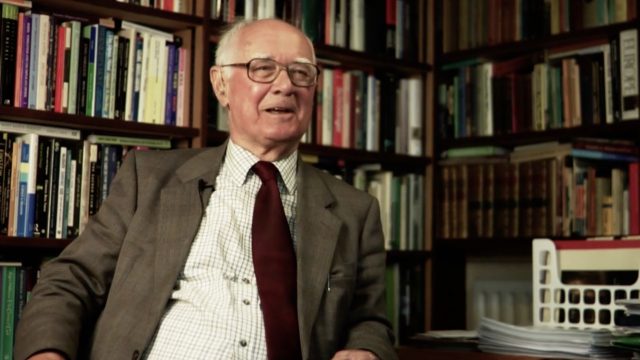
John Polkinghorne – a dear academic, theological and personal friend
Michael Welker
In 1993 the Center of Theological Inquiry in Princeton, under the leadership of Dan Hardy, sponsored a four-year consultation in which an interdisciplinary group of scholars (including the fields of cosmology, physics, biology, chemistry, environmental studies, philosophy, religious studies and theology) moved from an exchange via different disciplinary and individual academic approaches to the dialogue between science and theology. This is where John Polkinghorne and I met and first became intellectual friends and then, in the course of several years, also personal friends.
Together we developed international and interdisciplinary consultations and conferences, cooperated in the publication of articles and books, and even wrote one book together. John received the prestigious Von Humboldt Research Award and in this context came to Heidelberg for a number of extended visits. He invited me to Cambridge for a semester, and even once to the glorious Smith Feast before Christmas. For almost a quarter of a century I felt blessed by our personal and academic friendship.
In 2017, quite frail already, John contributed a one-page text entitled “Bottom-Up Thinking” to the Festschrift for my 70th birthday. He kindly called me his “oldest theological friend” and succinctly described what had brought us close. “I soon felt a strong resonance with Michael in his way of approaching questions of truth. As a scientist, I’m not inclined to start with grand self-evident general principles and then proceed to descend to the discussion of particulars. Too often these principles have turned out to be neither self-evident nor general.” He termed his approach “bottom-up thinking” and added: “I seek to approach theological issues in a like manner, as does Michael. It seems a perfectly natural way to proceed in the religion of the Incarnation in which the nature of God is believed to be revealed in the enacted history of the Word made flesh in Jesus Christ.”
The group in Princeton met annually for four years. In the second year, hoping for sound results by choosing a different approach, we decided to split into two camps in dealing with common questions and topics, namely into one part, the “top-down thinkers,” and the other the “bottom-up thinkers.” The participants chose their own group, and interestingly enough, each camp included scientists as well as theologians. I suppose it is not necessary to state expressly which side offered results after some hours of common work, while the other side continued their discussions into the night without reaching shared results. Actually, after four years we were not even ready for a joint book publication of the two groups. The journal “Theology Today” published seven of the “bottom-up” texts on “God, Temporality, and Evolution,” with a perceptive introduction by Patrick Miller, “Theology and Science in Conversation.”
Dan Hardy’s successor at the Center of Theological Inquiry in Princeton, Wallace Alston, invited John and me to orchestrate a new multi-year research project. We selected the topic “Science and Theology on Eschatology” and invited a group of scholars which even included biblical scholars of the Old and New Testaments. This cooperation led to a very successful book with the fine title, “The End of the World and the Ends of God: Science and Theology on Eschatology.” Its four parts were, first, On Eschatology in the Natural Sciences (subtitle: Catastrophes and Hope); second, On Eschatology in the Cultural Sciences and Ethics; third, On Eschatology in the Biblical Traditions, and fourth, On Eschatology in Theology and Spirituality. Soon a second edition came out, and translations into Korean and Chinese followed.
For a larger group of pastor-theologians who discussed the results laid down in the book, John and I wrote two more methodological chapters. One was called “Opening Windows unto Reality,” and the other “Springing Cultural Traps – The Science-and-Theology Discourse and the Common Good.”
In 2001 we published a book together with the title “Faith in the Living God: A Dialogue.” It came out in the US and in England, but also in Germany and China and after all these years has just been translated into Korean. In the chapter “The Search for Truth and Understanding in Science and Theology,” we describe our methodological commonalities. We regard our common approach as aiming at a “Critical and Self-Critical Realism.” We hold the conviction that “Faith is a ground for commitment, and for questioning our commitments; faith includes reliable knowledge, and at the same time is an awareness of the limits of knowledge.”
The second point of similarity is that we both are wary of generalizing abstractions, and therefore we seek to anchor our thought in concrete particulars. We both agree, in John’s words, that “experience and interpretation will always intertwine in hermeneutic circularity, but one should try to make the circles as tight and as small as possible.” We are also in agreement that science as well as theology has to speak of and explore unseen realities.
This statement with its reference to unseen realities does not mean that we have to give up bottom-up thinking and the claim to a critical realism. Rather, it requires improvisatory approaches and an epistemological pragmatism. Above all, it requires a concentration on theological content and its connectedness to historical and even empirical evidence. “We both seek an understanding of God that is not absolute and abstract, but rooted in the rich experience of Israel and the Church and principally manifested neither in ‘the starry heavens above’ nor in ‘the moral law within’, but in the person of Jesus Christ, crucified and risen.” We therefore “take the biblical witness of the Old and New Testaments with the utmost seriousness … [but do] not commit … to a fundamentalist sense of the ‘inerrancy’ of Scripture.” (136)
We continued the research on topics of eschatology with a strong concentration on the topic of the resurrection. With our partners from California, Ted Peters and Robert Russell, we published the book “Resurrection: Theological and Scientific Assessments.” The question of eschatological credibility was crucial for us. It made a thorough investigation of the biblical resurrection accounts necessary. It became very clear that the resurrection of Christ is not a physical reanimation and resuscitation. Only when one isolates some verses in Luke 24, one gets stuck with the impression of a resuscitation. All the other accounts present us with a strange tension between palpability and appearance. Here John’s statement turned out to be helpful, namely that the biblical resurrection accounts “speak of the continuity and the discontinuity between the pre-Easter Jesus and the post-Easter presence of Christ.”
The light appearances of the Resurrected leave us with the open question of how these appearances could be connected to the pre-Easter Jesus. – The stories of the empty tomb confront us with witnesses that the pre-Easter body was withdrawn. Still, various statements suggest that the empty tomb alone did not generate a belief in the resurrection. – The third group of witnesses dealing with encounters with the resurrected Jesus Christ emphasizes the tension between palpability and appearance, the experience of a theophany and doubt.
In our research, the notion of a spiritual body became crucial. It questioned old-style dualisms of physical body and mental spirit. An affirmation of the cultural and historical objectivity of the transfigured body is needed, an objectivity that calls for the participation of the witnesses in the glorified life, a participation that transforms the lives of the witnesses.
Later, we explored other eschatological symbol systems, such as the coming reign of God and the work of the divine Spirit, in order to gain access to spiritual realities and to correct simplistic equations of creation with physical nature and cosmos alone.
This wider view of creation also led to a fruitful set of new insights in the area of anthropology. Several consultations in Princeton dealt with this topic. They questioned all sorts of binary and dualistic concepts of personhood and asked for multidimensional perspectives on the human being. The most productive publication in this research was “The Depth of the Human Person: A multidisciplinary approach.” It involved physicists, biologists and psychologists, but also philosophers, theologians, historians and law scholars from different countries. Many participants found St. Paul’s highly differentiated anthropology most helpful: the material flesh, the partly material, partly spiritual body, the soul as a mental and bodily unity, the heart as a unity of cognitive, emotional and voluntative activities, conscience as a polyphonic ensemble of voices in need of becoming a clear inner dialogue and orientation, and finally the power of the human spirit in its ability to reach out far into the past and into the future and even to unseen realities.
We brought the theology and science dialogue into contact with Pentecostal minds and forms of spirituality, but also with Russian Orthodox traditions of thought. Many old ideas about the Spirit as a simply numinous entity or as a core of a totalitarian metaphysics, or as a just mentalist and intellectual power had to be corrected. In all these cases the dialogue between theology and science proved to be extremely helpful. A very difficult step was the inclusion of the areas of law into the dialogue. It started with the huge project “Concepts of Law in the Sciences, Legal Studies, and Theology.” It turned out that many aspects of the natural law traditions needed to be questioned. John presented a very sophisticated notion of the laws of nature.
In 2012, we held a big conference in Heidelberg under the title, “The Science and Religion Dialogue: Past and Future.” This conference, initiated by Mary Ann Meyers, celebrated the 100th anniversary of Sir John Templeton and 25 years of his Foundation, which up to this day has been one of the leading supporters of the Science and Religion or Science and Theology dialogue. John gave a powerful lecture on the topic “The Search for Truth.” He argued that there is no universal rationality that fits all situations, but entities have to be thought about in the manner that conforms to their actual nature. He praised the power and the modesty of scientific approaches, asking “What are the processes by which events occur in the physical world?” “Addressing questions of meaning and value and purpose is deliberately bracketed out, but this by no means implies that these questions are not of the greatest significance.” He therefore argued for a cousinly relation between science and theology. But he also warned against rather thin concepts of divinity, such as “the great mathematician or the cosmic architect.” He also acknowledged that many scientists are suspicious or even contemptuous of metaphysics, asserting that they have no need for such speculative activity.
We were both united in our strong reserve against totalitarian metaphysics, but were in search of integrating general contact theories, compatible with a consequent bottom-up thinking. Alfred North Whitehead spoke of “a metaphysics” (as opposed to the usual “the metaphysics”), a metaphysics that arises when we ask how basic concepts in one area and one relative world of experience can be related to another area and relative world of experience. Whitehead stated that such a metaphysics can arise out of mathematized science, out of philosophical or religious thinking and theories and even out of a sophisticated common sense. But each of these metaphysics has to be tested whether it can serve as a fruitful contact theory between different areas of knowledge and whether it can develop sustainable truth claims.
John described our common striving as follows. “We are committed to the stance of critical realism, that is to say, to a belief that the aim of inquiry is to attain an understanding conformed to the way things actually are. That is why, for us, religious faith is primarily concerned with the Reality of God. We encounter that Reality as it is made known to us in the gracious gift of the divine presence, eliciting in its turn a human response. That response involves the whole person, going far beyond the mere assent of the intellect, although, of course, including that assent.”
For me, a devoted academic theologian who wrestles with processes of self-secularization and self-banalisation in my theological and ecclesial environments, this intellectual assent was crucial. John, however, with his wider view on spiritual realities, added, “For many Christians, the prime expression of their spiritual life is worship within the eucharistic liturgy of the church. Liturgy provides a common framework that both contains and enables the individual responses of the worshipers, taking place within the common life of the gathered community of the faithful. It affords a pattern within which the search for truth by the bottom-up thinker … can also find a place.”
Among my books, the one on the Holy Spirit and the one entitled “What Happens in the Lord’s Supper?” particularly appealed to John, very likely because of their practical orientations. He himself, however, with his repeated plea for “liturgy-assisted logics,” proved to be the stronger practical theologian of the two of us. Even in this respect, I remain challenged and most grateful for his example.