Science, Religion … and Literature
by The Revd Canon Dr Michael Fuller
How do people engage with issues around science and religious belief? Readers of this blog will of course be familiar with the contours which the ‘science and religion debate’ have followed since Ian Barbour’s groundbreaking work in the 1960s: the search for philosophical, methodological and historical ‘bridges’ which might link these two areas of human activity, the focus on ‘hot topics’ like divine action and the mind-body problem, and so on. More recent developments have seen the extension of the field of science and religion studies to acknowledge non-Western religious traditions – and to acknowledge also the richly varied nature of the scientific enterprise. Science and religion are now rightly thought of as complex and variegated phenomena, such that it is no longer possible to think of there being a single ‘relationship’ between two clear and uncontested concepts.
All this scholarship is, of course, fascinating in and of itself. It may also have served a purpose for some in breaking down barriers of incomprehension and mistrust between either side in the science and religion debate. But what of the wider public? It is likely that this academic approach is not how many members of the general public encounter reflections on science and religion. Many doubtless still do so through the loudly-raised voices of controversialists parading the parodies of the ‘conflict myth’; but there are others, too, taking what might perhaps be considered more tangential routes into reflecting on the roles played by science and religion in people’s lives.
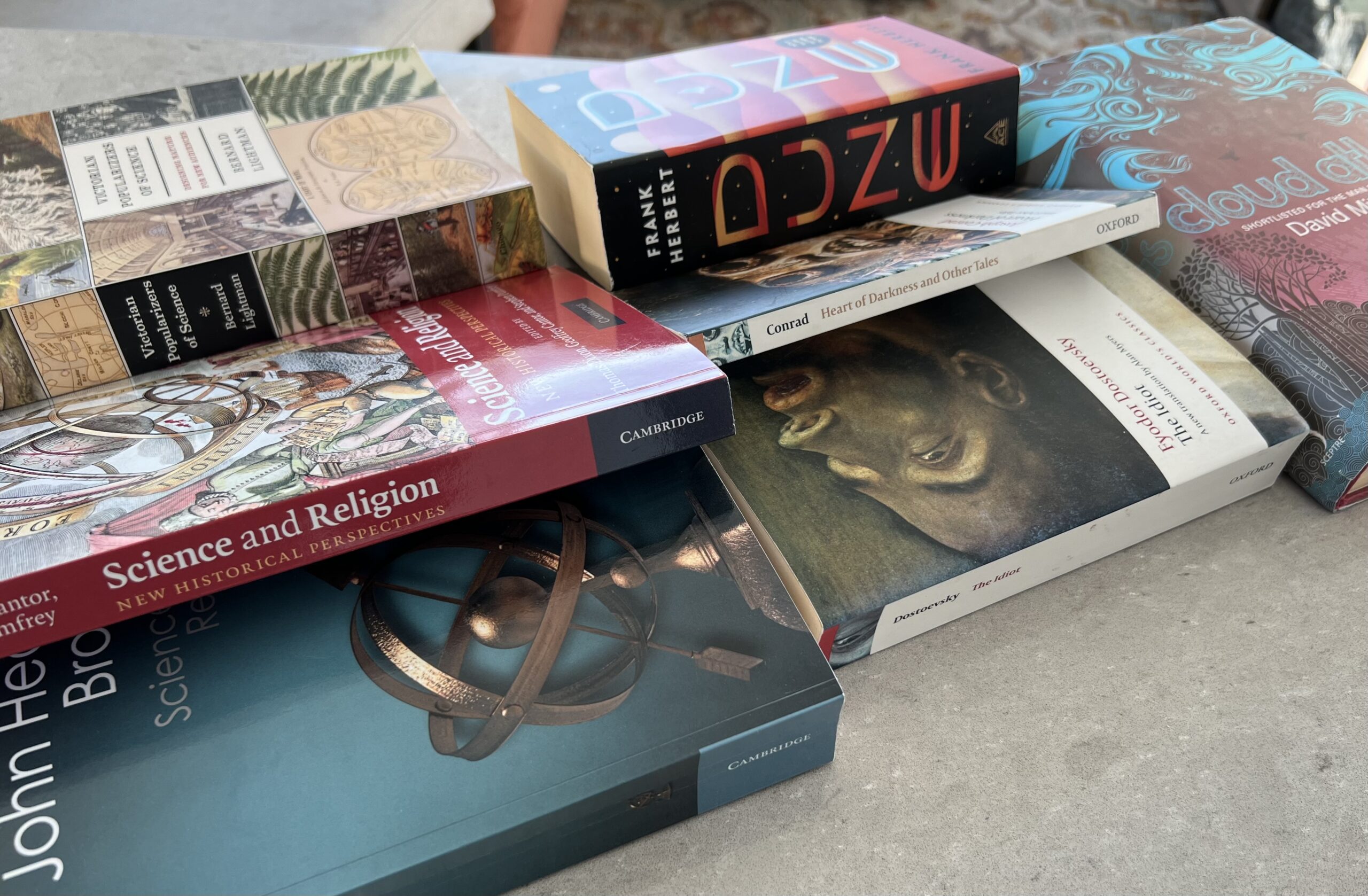
I’m thinking here of the striking fact that, for centuries now, science and religion in the West have encountered one another not just in the work of scholars and polemicists, but also through their juxtaposition in works of literature – novels, short stories, poems and plays. Some of these may themselves be directed towards a small constituency, being appreciated primarily by devotees of these art forms; but others are aimed more squarely at the general public. Might they encourage reflection and engagement with important themes regarding the relationships of science and religion in ways which more formal academic discourse cannot? In contrast to more cerebral approaches, might authors who are engaging with the imagination of their readership advance the conversations around science and religion in fresh and original ways?
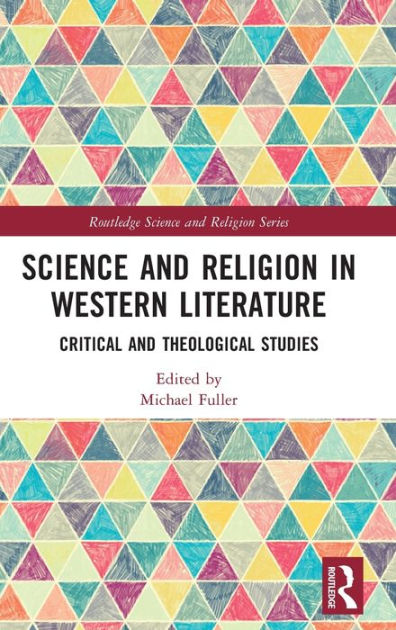
I have recently edited a book, Science and Religion in Western Literature: Critical and Theological Studies (Routledge 2022), which draws together contributions from scholars in the UK and beyond to examine some of these literary explorations of the relationships between science and religion. This volume presents some richly-contrasted examples of how literary works over the last 300 or more years have imaginatively addressed particular concerns of the day regarding how science and religion can sit alongside one another.
Now, it might be thought that human faculties like the imagination have little to do with science, and little to contribute to the dialogue of the sciences with religion. Tom McLeish is among those who would maintain that this could not be further from the truth. He recently commented:
[I]f it is [science’s] task to re-conceive the universe, to create a mental map of its structure, the relationships of force and field, of the evolution of structure and complexity, to understand the patterns of matter from the earliest moments of time to its closing aeons, from the smallest fluctuation of space-time to the immensities of the cosmos, and to reconcile all this inhuman otherness to the finitude of our minds, then what task could possibly call on higher powers of imagination? … If writing a sonnet is the collision of creativity within constraint of expressing within a tight form and with new potency the human experience of the world, then science also becomes the conception of imagination within constraint (McLeish 2019, 27).
The imagination is of course fed by many things: not just be the kinds of phenomena cited by McLeish, but also by our capacities for awe and wonder – and the parts played by these in the prosecution of science have also been commented upon (see, e.g., De Cruz 2020).
So, is there perhaps common ground (one might almost say, a common playground) for science and religion here: the world of the imagination, which acknowledges the ability of the human mind to transcend commonplace experience, and which has the capacity to bring positive benefits to scientific and religious activity alike? If McLeish’s ‘imagination within constraint’ is not only relevant to the practice of cosmology and the writing of a poem, then might it – indeed, should it – be applied also to the generation of fresh thinking about the interactions of science and religion themselves? If these questions are answered in the affirmative, then the outworkings of the human imagination in the field of literature can readily be seen as an important area in which we might see new forms of interaction between science and religion take place.
This observation might appear almost trivially obvious. To take a popular example, for over a century the genre of Science Fiction has been a conceptual laboratory for thinking about some of the ramifications of science. From thought experiments which ask, ‘What if such-and-such a thing were to occur?’, to explorations of the ethical dilemmas that might be presented by scientific novelties, to attempts to think through the effects of global catastrophes, such writings can be of considerable value. Not only does such work allow us to consider these topics in theory before they actually arise in practice: it is an interesting question itself to consider the extent to which imagined future possibilities drive present-day research, when it comes to areas like space exploration for example. (And this applies not just to research. The impact of franchises like ‘Star Trek’ on the design of modern technologies, such as mobile phones, tablets and laptops is immediately evident.)
To take another example of sci-fi blazing a trail for subsequent real-life developments, consider the vast literature concerning robots which has proliferated since Karel Čapek coined this word a century ago (Čapek 1990). The kinds of relationships that humans may have with robots, and the limitations and dangers of those relationships, may originally have been considered ‘thought experiments’; but with the arrival of robots which can simulate interactions with humans, such literature has come to seem far-sighted, and valuable in terms of its enabling us to think through some of the consequences of artificial intelligences before the possibility existed to create them. Isaac Asimov’s ‘Three Laws of Robotics’, for example, might now be considered to have practical as well as theoretical value (cf. Asimov 2018, vi). Čapek, a prodigiously gifted writer who frequently explores religious and scientific themes together in his writings, is one of the authors featured in our book, alongside other writers who have contributed to the Science Fiction genre, like Aldous Huxley.
It is surely uncontroversial to say that more people engage with literature of this kind than engage with scholarly writing around science and religion: I dare say that there are rather more people who have read books by, for example, Philip Pullman (another author considered in our book) than there are people who have read Ian Barbour. Of course, being popular does not necessarily mean being scrupulously academic, and it might be felt that there are problems with explorations of science and religion carried out in popular writings. Scientific ideas may be presented inadequately or eccentrically: Marie Corelli, a nineteenth century novelist discussed in our book (an author who, in her day, outsold Dickens), might be considered to exemplify this. Religious ideas may be caricatured: some recent literature around the concept of the Singularity, again discussed in our book, certainly seems to lean in this direction. In cases such as these, it is important to note how public perceptions might be driven along by visions which might be considered deficient: this in itself is important when thinking about the reception of both scientific and religious ideas.
To be sure, the imaginative engagement of science and religion in literary contexts can never replace careful, academic study. But such engagement may, I suggest, serve three purposes.
First, it can widen the terms of the debate between science and religion. This can happen in many ways. For example, it might be said that within both scientific and religious communities of practice there exist orthodoxies which are generally respected, and departures from which are frowned upon. This may result in a certain caution as members of those communities engage with others. Literary experimentation might engender a more speculative approach which can extend beyond such orthodoxies and which, potentially at least, can encompass new perspectives on sciences and religions themselves, thereby furthering fresh and, potentially, deeper engagement between the two.
Second, a sad consequence of much of the antagonistic language employed by those prosecuting the ‘debate’ between science and religion in the West today might well be that many people find such language so off putting that they refrain from engaging with the issues presented in that debate. In fact, as one might intuitively expect, the views of many scientists and religious people are not as polarised as advocates of the ‘conflict thesis’ might maintain: this is indicated by the research of Elaine Ecklund and others (Ecklund 2010; Ecklund and Schietle 2017) in the North American context, and by a recent empirically-based report from the Theos thinktank (Spencer and Waite 2022) in the UK. Nevertheless, it might well be the case that those who have found polarised and polarising popular writing on science and religion to be inadequate and/ or offputting might find a more convivial space for exploring and envisioning their interactions in the pages of works of literature. And it may well be that they come to a deeper understanding of what science and religion might mean for them as a consequence.
Third, that convivial space may offer also an opportunity for reflection on some of the deep questions that stir and stimulate us all, bringing together scientific and religious perspectives in the search for responses (not necessarily answers) to those questions. How can contemporary understandings of the natural world inform the faith of those who see that world as the handiwork of God? (Our book explores both historical and more recent examples of how poets have explored precisely this question.) How might we address pressing ethical issues raised, for example, by human reproductive technologies, or by a future impacted by devastating climate change? (Again, our book offers examples of how novelists have addressed precisely these issues.)
It is exciting that the next conference of the European Society for the Study of Science and Theology, to be held in Split, Croatia in 2024, will be considering the topic of ‘Sciences, Theologies, Fictions: The Narrative Construction of Science and Religion’. The roles played by narratives and fictions is clearly a topic around which much can be said in the field of science and religion. Our book is, of necessity, limited in its scope in that it considers exclusively the realm of Western literature (and mostly literature written in the English language, to boot). There is much that remains to be learned from the ways in which the literature of other languages, and imaginative writings anchored in non-Western religious traditions, have explored the interactions of science and religion in all the multifarious contexts in which they have interacted, both historically and geographically; and the multidimensional aspects of the study of science and religion can only be enhanced as a result. However, we very much hope that Science and Religion in Western Literature: Critical and Theological Studies might be instrumental in opening up new and fruitful avenues of research.
Bibliography
Isaac Asimov (2018). I, Robot (HarperVoyager).
Karel Capek (1990). ‘RUR’. In P. Kussi (ed.), Toward the Radical Centre: A Karel Capek reader (Catbird Press), pp. 34-109.
Helen De Cruz (2020). ‘Awe and Wonder in Scientific Practice: Implications for the relationship between science and religion’. In M. Fuller, D. Evers, A. Runehov, K.W. Saether and B. Michollet (eds.), Issues in Science and Theology: Nature – And Beyond (Springer), pp. 155-168.
Elaine Ecklund (2010). Science vs. Religion: What scientists really think (Oxford University Press).
Elaine Ecklund and Christopher P. Schietle (2017). Religion vs. Science: What religious people really think (Oxford University Press).
Tom McLeish (2019). The Poetry and Music of Science: Comparing creativity in Science and Art (Oxford University Press).
Nick Spencer and Hannah Waite (2022). ‘Science and Religion’: Moving away from the shallow end (Theos). Available online at https://www.theosthinktank.co.uk/research/2022/04/21/science-and-religion-moving-away-from-the-shallow-end (accessed 27.ix.22).