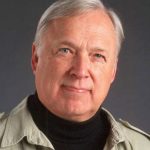
Holmes Rolston III: In Memoriam
Ted Peters
Planet Earth will miss its renowned paladin, Holmes Rolston III (1932-2025). He died on February 12 this year. Holmes was an academic champion of environmental ethics and public policy who influenced philosophers, theologians, scientists, and the wider public.
A New Environmental Ethics
Like a biblical prophet, Holmes announces the coming of a day of judgment. “The worry for the next century is that humans may destroy their planet and themselves with it,” writes Holmes in the second edition of his A New Environmental Ethics (Rolston III, A New Environmental Ethics 2nd ed, 2020, 245). This is Holmes’ prophetic judgment: we Homo sapiens on Planet Earth are risking the destruction of our home. Unless, of course, we repent.
This repentance would take the form of turning away from unbridled short-term consumption and embrace the vision of long-term sustainability. In my words, we should guide ourselves by a vision of a just, sustainable, participatory, and planetary society. To actualize such a vision, Holmes recommends a first step: “culture must be integrated with nature” (Rolston III, A New Environmental Ethics 2nd ed, 2020, 245).
Integrating human culture with our natural environment is a tall order. How should we go about it? By collecting and uniting wisdom.
“The wisdom we need is not just that of politicians, generals, technocrats; it is that of geologists in the philosophical sense, those who know the logic of their home, oikos; or, if we may borrow a religious word, ecumenists, those whose vision is the oikumene, the whole inhabited Earth. We need environmental ethics without borders” (Rolston III, A New Environmental Ethics 2nd ed, 2020, 244).
That’s the future. What about the past? What about our evolutionary past? We might best place Holmes in the category of theistic evolution or perhaps even naturalism. Both the Bible and Darwin tell us much about ourselves.
What a marvel of evolution is the human spirit!
Because “Genes and culture co-evolve,” (Rolston III, Surprisingly Neuroplastic Human Brains 8/2019, 398), Holmes looks backward at pre-human evolution and forward to a future cultural revolution. We need a cultural revolution to ensure that our human genome will pass through the environmental crisis at hand.
Even though physical cosmologists look back 13.8 billion years to the Big Bang responsible for our universe, Holmes discovers three such bangs. The term, Big Bang, says Holmes Rolston III, means what others intend with the term, emergence. Big Bang is “a metaphor for critical, exponential, nonlinear bursts with radical consequences for exploring new state spaces with novel combinatorial possibilities” (Rolston III, Three Big Bangs: Matter-Energy-Mind 2010, Kindle 78). On his list are three moments of genesis: the genesis of the universe, the genesis of life, and the genesis of the human mind.
“Both the first and the second big bangs resulted in us: the Homo that is so sapiens. A third has taken place within us, the mind’s big bang in the explosion of cultures with radical capacities for the generation and cumulative transmission of ideas—knowledge, wisdom…. The measure of all three is radical genesis; in the end we must ask the questions with which Genesis begins: wondering about creation resulting in persons who image God” (Rolston III, Three Big Bangs: Matter-Energy-Mind 2010, Kindle 115).
The third Big Bang – the evolution of the human mind followed by the appearance of spiritual transcendence – emerged as a new and unprecedented leap in being.
“Homo sapiens is the only part of the world free to orient itself with a view of the whole. We are not free from the worlds of either nature or culture, but free in those environments. That makes us, if you like, free spirits; it also makes us self-transcending spirits. That is the peculiar genius of the human person or spirit. We alone can wonder where we are, who we are, what we ought to do” (Rolston III, Three Big Bangs: Matter-Energy-Mind 2010, Kindle 114).
Aren’t we just the most marvelous of all the evolved species! Shouldn’t we humans be so very proud of ourselves!
And just think: our species within only a century or so will make ourselves go extinct. Again, what a marvel is spirit, culture, greed, tribalism, short-sightedness, and stupidity! Unless, of course, we repent and embrace a new environmental ethics. This is the prophetic call of Holmes Rolston III.
Holmes Rolston III
The namesake grandfather and father of Holmes Rolston III were both Presbyterian ministers. Perhaps because ein Apfel fält nicht weit vom Stamm, the young Holmes also became ordained in the Presbyterian Church USA. He studied for his doctorate under Thomas Torrence (1913-2007) – known for his pioneering work in Theology and Science — at the University of Edinburgh, earning his Ph.D. in 1958.
Holmes spent his teaching career on the philosophy faculty at Colorado State University, becoming University Distinguished Professor in 1992. He delivered the Gifford Lectures at the University of Edinburgh in 1998 and 1999. Then he was named Templeton Prize Laureate in 2003. Villanova University awarded him the Mendel Medal in 2005.
Students in philosophy as well as theology remember well his many significant books such as Philosophy Gone Wild (1986); Genes, Genesis, and God (1999); Environmental Ethics: An Anthology (2003); Three Big Bangs (2011); Nature, value, duty: life on earth with Holmes Rolston III (2007), and the 2nd edition of A New Environmental Ethics (2020).
We in the field of Theology and Science have benefitted greatly by the exploratory and trailblazing work of this colleague, scholar, and teacher. Holmes Rolston III was a good steward of his inborn and acquired talents.
References
Rolston III, Holmes. A New Environmental Ethics. London: Routledge, 2nd ed, 2020.
—. Genes, Genesis, and God. Cambridge UK: Cambridge University Press, 1999.
Rolston III, Holmes. “Surprisingly Neuroplastic Human Brains.” Theology and Science 17:4, 8/2019: 395-402.
—. Three Big Bangs: Matter-Energy-Mind. New York: Columbia University Press, 2010.
▓
Ted Peters is Distinguished Research Professor Emeritus of Systematic Theology and Ethics at Pacific Lutheran Theological Seminary and the Graduate Theological Union. Along with Robert John Russell he co-edits the journal, Theology and Science, published by CTNS. He is author of Playing God? Genetic Determinism and Human Freedom (Routledge, 2nd ed., 2002) plus a single volume systematic theology, God—The World’s Future (Fortress, 3rd ed., 2015). Peters has edited books such as The Promise and Peril of AI and IA: New Technology Meets Religion, Theology, and Ethics (ATF 2025) and with Arvin Gouw and Brian Patrick Green he co-edited Religious Transhumanism and its Critics (Lexington 2022). Visit his website, TedsTimelyTake.com and his Patheos blog site on Public Theology.
▓