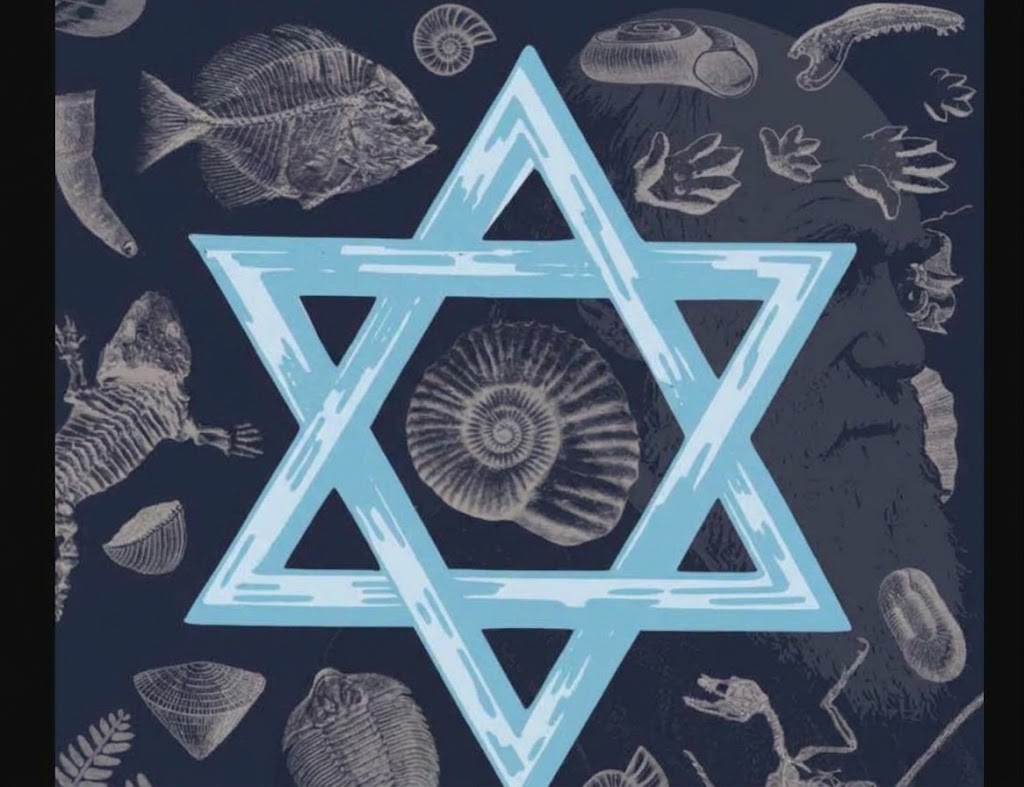
When Darwin met the Jews
by Daniel Langton
When Charles Darwin published On the Origin of Species in 1859, he could hardly have anticipated that within fifteen years his ideas would be expounded in Hebrew and compared with the teachings of the ancient Jewish sages. Yet in 1874 Naphtali Levy, a traditionally educated Polish Jew, published Toldot Adam (The Origins of Man), one of the earliest substantial Hebrew engagements with Darwinian evolution. Having encountered the Origin in German translation, Levy became convinced that modern science could illuminate – and sometimes correct – traditional Jewish understandings of the natural world.
Levy delighted in finding anticipations of evolutionary ideas in rabbinic literature. Genesis 2:7 describes God forming Adam from “dust from the ground” (afar min ha-adamah). Levy cited Genesis Rabbah 14:7, where Rabbi Huna observes that afar (“dust”) is grammatically masculine while adamah (“ground”) is feminine: the divine Potter therefore combines the male afar with the female adamah to make his vessel. Levy transformed this ancient wordplay into an anticipation of the emergence of organic life from inorganic matter. Elsewhere, a rabbinic tradition that Adam originally possessed an animal-like tail became evidence for Levy of an animal stage in human ancestry.
Even Eden became evolutionary. Levy’s primitive humans were caught up, like other animals, in the Darwinian “struggle for existence”. “Highest Providence” (hashgachah ha-romemah) brought Adam to Eden, where he had to “battle against the earlier inhabitants of the Eden area”. This was a decidedly Hobbesian paradise: competition for resources and the pressures of social existence became the mechanisms through which morality itself evolved. Even the biblical “voice of God” (kol Elohim) could be naturalised as the “voice of instinct” (kol instinkt).
And where the two could not be reconciled, Levy was remarkably candid about which should prevail. Of the Darwinian picture of primitive humans descended from ape-like ancestors, he declared: “I believe more in his theory than the text which says ‘Let us make man in our image, after our likeness’!” His “Book of Nature” could therefore become the “key to the Book of Torah”.
The story has a delightful coda. In 1876 Levy sent Toldot Adam to Darwin, explaining that he wished to teach “the children of my people, the seed of Jacob” the evolutionary torah that Darwin had given “for an inheritance to all the nations of the earth”. Darwin was fascinated. He later recalled with evident pleasure: “Even an essay in Hebrew has appeared on [The Origin of Species], showing that the theory is contained in the Old Testament!”
But Levy was only one Jewish reader of Darwin. Other Jews would reject evolution, delimit its authority, transform it into theology, or enlist it in arguments about morality, race, Zionism and Jewish identity.
No single Jewish Darwinism
Levy’s enthusiasm should not be mistaken for a characteristically ‘Jewish’ response to Darwin. The pages of the Jewish Chronicle, the weekly Anglo-Jewish newspaper first established in 1841, reveal a range of views. Some writers insisted that Judaism had nothing to fear from evolutionary science; others thought Darwinism bad science and potentially worse morality. Some accepted evolution while doubting natural selection, and others argued that science and religion were answering fundamentally different questions. The resulting debate was a cacophony rather than a consensus.
There was nevertheless a recurrent conviction that Judaism was unusually well equipped to cope with the challenge. In 1872 Britain’s Chief Rabbi, Nathan Adler, contrasted Judaism with contemporary Christianity, observing that “such a contest must be slight or superficial in Judaism, where faith and reason go hand in hand”. Others, also writing before the turn of the century, went further. One Jewish Chronicle writer asserted that “there is only one theology in existence which is not antagonistic to science – this is Jewish theology”; another that “Judaism has nothing to fear from the advancement of science, but everything to gain”. Such claims were hardly disinterested descriptions of Judaism. Darwin provided Jews with an opportunity to define their religion as rational and scientifically sophisticated by contrasting it with a Christianity supposedly embroiled in warfare with modern science.
Rabbinic literature could be enlisted in this exercise, too. An extraordinary Jewish Chronicle essay in 1875, entitled ‘Darwin and the Talmud’, claimed that an idea regarded as novel and even anti-scriptural had actually been “a view held centuries ago by the Talmud”. Its evidence came from the Jerusalem Talmud (Shabbat 1:3), which describes extraordinary transformations of one animal into another over periods of seven years (e.g. a field mouse becoming a wild boar and a head-louse a scorpion). To nineteenth-century readers looking for precedents for the transmutation of species, even such decidedly pre-modern natural history could acquire a Darwinian complexion.
Yet other Jews were much less impressed by attempts to make ancient texts anticipate modern biology. The American Reform rabbi Joseph Krauskopf, whose Evolution and Judaism appeared in 1887, thought such harmonisation intellectually dishonest. Science should be allowed to explain natural phenomena rather than having its conclusions squeezed into texts written in a very different intellectual world. Indeed, for Krauskopf evolution was not merely compatible with Judaism: it helped to legitimate a Judaism capable of evolution itself. He was quite prepared to reject the binding authority of the Talmud and Shulchan Aruch (the influential sixteenth-century code of Jewish law) while simultaneously treating evolutionary theory almost as a new revelation.
While the Polish traditionalist Levy had found Darwin in Torah and Midrash, and an anonymous Victorian British writer had found him in the Talmud, the progressive Krauskopf thought the very attempt to find modern science in ancient texts misguided. But all three could embrace evolution in some sense. What divided them was not simply whether Darwin was right, but what accepting Darwin meant for Judaism itself.
From biology to theology
For some Jewish thinkers, Darwinism not only raised questions about the interpretation of the Hebrew Bible but provided a new language in which to think about God, morality and history. This was particularly striking among several American Reform rabbis. Kaufmann Kohler, Emil G. Hirsch and the aforementioned Joseph Krauskopf extended the idea of evolution far beyond biology, applying it to religion and ethics and even to the cosmos itself. Judaism, on this account, had survived the two millennia of Christian persecution and adapted to countless different environments along the way. In a very real sense, religion in general, and Judaism in particular, could be regarded as an evolving phenomenon.
This had potentially radical consequences for morality. Traditionally, Jewish ethics had been grounded in divine revelation: God gives the Law, beginning with the biblical commandments and elaborated through rabbinic tradition. But evolutionary theory suggested another possibility. Moral behaviour might itself have a natural history. Kohler and Hirsch explored how the demands of social existence could have transformed an originally animal humanity into an ethical one. In this respect they shared something surprising with the much more traditional Levy: the origins of morality could be explained, at least in part, by evolutionary processes rather than simply by revelation at Sinai. Across the Jewish spectrum, Darwin was making it possible to ask not only how human bodies had evolved, but how human values had evolved, too.
Jewish mysticism provided another route. Writing in Hebrew, Italian and French from the 1860s until the turn of the century, the Italian rabbi and kabbalist Elijah Benamozegh gradually shifted position over time, eventually arguing that the teaching of the common descent of living things was consonant with the Kabbalah. Biological evolution became one manifestation of a much grander cosmic process in which nature, humanity, morality and religion were all developing. For Benamozegh this was ultimately universalist: humanity was progressing towards a shared spiritual and ethical future.
A generation later, Abraham Isaac Kook, the first Ashkenazi Chief Rabbi of Mandatory Palestine and one of the formative thinkers of religious Zionism, approached evolution rather differently. Kook was not much interested in Darwin’s particular mechanism of natural selection, per se. What attracted him was the idea of an ascending, developing universe, which he believed resonated with the Kabbalistic picture of a broken cosmos moving towards restoration. And like so many before and after him, he viewed Darwinism as progressive in nature. “Evolution, which proceeds on a course of improvement,” he wrote, “offers us the basis of optimism in the world.” Everything “evolves and ascends” towards the good.
But Kook’s engagement with evolution was also political. Secular Zionist pioneers in the Land of Israel embraced modern secular culture, of which evolutionary science had become an important symbol. Kook believed that their work rebuilding the Jewish homeland formed part of a divine process whether they recognised it or not. Rather than forcing religious Jews into an unnecessary confrontation with naturalistic evolutionary theory, he urged them to recognise whatever truth it contained. His “creative evolution” could therefore help bridge the increasingly fraught divide between religious and secular Zionists.
Thus the same evolutionary idea could be used to naturalise morality by a Reform rabbi, illuminate Kabbalah for an Italian mystic, or help reconcile religious and secular Jews in Palestine. Darwin’s significance for modern Jewish thought cannot therefore be measured simply by asking how many Jews “accepted evolution”, but rather what they made evolution mean.
Evolution and the Jewish future
Evolutionary language did not remain confined to arguments about scripture and theology. Jews also began to apply it to themselves. Why had the Jewish people survived for so long? What effects had persecution, migration and intermarriage had upon them? And could evolutionary ideas help shape their future?
Victorian and Edwardian Jews sometimes answered the first question with a certain mischievous satisfaction. In 1872 the Jewish Chronicle observed that Darwin’s “Selection of the Fittest for survival” was “highly flattering to the Hebrew people”: had Jews not been fit for survival, they would surely have disappeared under centuries of oppression. A few years later another writer connected Jewish persistence with natural selection and even with the Talmudic maxim kol d’alim gavar (roughly, “the stronger prevails”). Darwinian language was becoming a way of thinking about Jewish history itself.
By the early twentieth century the implications could become considerably darker. Evolutionary theory had become entangled with contemporary race science and eugenics. Jews were overwhelmingly the victims of racial theorising, but they were not immune to its intellectual attractions. Some Jewish scientists and Zionist thinkers asked whether selection, heredity and environment could explain Jewish characteristics and even whether those same forces might be consciously harnessed to create a healthier Jewish future.
The Zionist sociologist Arthur Ruppin provides a somewhat disturbing example. He regarded the return to Palestine not only as a political and cultural project but as an environment in which a transformed Jewish population might emerge. In 1919, in a German essay entitled “Selection of the Fittest”, he advocated immigration policies designed to exclude those regarded as physically or mentally unfit while favouring those thought capable of strengthening the population. Other Jewish eugenicists in 1930s Mandatory Palestine went further in modern Hebrew. Abraham Matmon wrote about the “racial improvement” of the Jewish people, while Yisrael Rubin regarded the gathering together of Jews from different parts of the world as an extraordinary eugenic experiment from which a new Jewish type might emerge.
This is an uncomfortable but essential part of the story. Darwin’s dangerous idea not only challenged traditional understandings of the nature of Judaism and the divine origins and authority of Jewish mitzvot and ethics, but it could also be recruited into Jewish racial thinking and programmes of social engineering.
Evolution after Auschwitz
The relationship between Darwinism and Jewish history became still more complicated after the Holocaust. The familiar often-told story connects evolutionary language with Nazi racial theory, Social Darwinism and eugenics. But there is another, less familiar story: Jewish thinkers also drew upon evolution when trying to reconstruct Jewish theology after the catastrophe of the Shoah.
In the 1930s Mordecai Kaplan, the founder of Reconstructionist Judaism in the U.S., had followed some Reform Jewish thinkers and already come to understand Judaism itself in evolutionary terms. Religions were not fixed systems handed down unchanged through history; they were evolving civilizations. Kaplan would even spoke of “spiritual selection”: human beings could consciously develop ethical and religious forms that furthered human life rather than simply submit to the brutal materialistic logic of natural selection. Nazi Social Darwinism represented for him precisely what happened when the biological struggle for existence was illegitimately converted into a programme for human society.
This focus on evolution also transformed Kaplan’s understanding of God. Rather than an external supernatural being periodically intervening in nature, God could be conceived as “the creative life of the universe”: the power or process through which order, life and ultimately human ethical possibility evolved or emerged. This process theology, which resonates with the ideas of the French and British philosophers Henri Bergson and Samuel Alexander, among others, had stark consequences for the problem of the Holocaust. Kaplan did not need to explain why an omnipotent God had permitted Auschwitz, because his God was not that sort of supernatural agent in the first place.
Hans Jonas, a German-Jewish philosopher whose mother was murdered at Auschwitz, travelled by a very different route. His philosophy of biology began with the extraordinary fact that an apparently indifferent material universe had generated living organisms, consciousness and eventually creatures capable of moral responsibility. His post-Holocaust theology imagined a God who, in creating an autonomous and evolving universe, had relinquished the power to control what happened within it. God could suffer with creation but could not simply intervene to prevent human beings from committing evil. Auschwitz was therefore not part of a divine plan: responsibility for it remained human.
For Jonas, this ultimately generated an “imperative of responsibility”, that is, an ethical obligation towards other human beings, other forms of life and the world upon which life depends. Significantly, he claimed to derive this ethical imperative from reflection upon biology rather than from scripture or religious tradition, but it is clear that he drew inspiration from Jewish mysticism: he alluded to the Kabbalistic idea of tsimtsum (God’s self-contraction or withdrawal) to present a God who left the world to its own free development.
Conclusion
As I argue in my book, Darwin in the Jewish Imagination, one striking feature of Jewish engagement with evolution was the early emergence of pan(en)theistic understandings of God, evident in different forms among different thinkers. These included some of those we have considered here, including Naphtali Levy, Joseph Krauskopf, Emil Hirsch, Kaufmann Kohler, Elijah Benamozegh, Abraham Isaac Kook and, later, Mordecai Kaplan. But others, too, were panentheistic in approach, including the philosophers Samuel Alexander and Henri Bergson, who influenced the process philosophy of Whitehead. Rather than producing a single Jewish response to Darwin, then, evolutionary theory became a remarkably adaptable intellectual resource through which Jews could rethink scripture, morality, Jewish identity and history, and even the nature of God. It is striking just how early and how frequently Jewish evolutionists located the divine not outside the natural world as an intervening agent, but within, through, or intimately bound up with its evolutionary processes.