Humanity, Our Microbiome, and Our Relationship with God
Dr John F Pohl MD DThM
From a metaphysical perspective, advances in science are very helpful in expanding our definition and understanding of God. The discovery of a vast and expanding universe aids in our realization that humans are just a tiny part of God’s wonderful creativity. Ideas surrounding quantum indeterminacy suggest that the substratum of reality may indeed be random and, thus, have creative potential for nature. Do such metaphysical considerations exist in the biological sciences? Yes, when one considers the human microbiome and its effect on our species.
The human microbiome is immense and consists of approximately 10¹³ microorganisms for which the majority of these tiny creatures exist within the human gastrointestinal (GI) tract.1,2 Although bacteria dominate the GI ecosystem, other entities such as viruses, fungi, and archaebacteria also are present and influence GI microbiome function.3,4,5 Each individual human and their associated microbiome can be defined as a combined “holobiont” although theoretically the “holo” or “whole’ can be extended to its interaction with other biological entities, the environment, human culture, and all of nature through each organism’s tasting, eating, absorbing, breathing, touching, secreting, and removing of waste.6
The human microbiome has the inherent ability to keep the human body at homeostasis when considering biological activity such as digestion, nutrient absorption, and immune function.7 However, a pathologically-altered microbiome can negatively affect the health outcome of the host, and much basic science and clinical research has been undertaken in this field of study. Examples abound. For instance, dysbiosis (or an altered microbiome which leads to a pathogenic state) has been proposed for diseases such as Crohn disease and colon cancer.8,9 Patients with cystic fibrosis who have specific “protective” bacteria in their GI tract tend to have less dangerous bacteria in their lungs. This so-called “gut-lung axis” suggests that bacteria in one location of the human body can affect bacterial species type and diversity in other parts of the body leading to changes in the microbiome, the immune response, and subsequent human health.9 Importantly, a microbiome presence of specific bacterial species variety may have an effect in human neurology in the setting of various disorders including Parkinson’s disease, Alzheimer’s disease, and anxiety. One could consider such interactions as part of the “brain-gut axis.”10,11,12,13
Scientific research in the area of the human microbiome often can be difficult due to the spectrum of differences in the human presentation of disease, exact determination of bacterial species (and other microorganisms), and differences in bacterial strain and colony-forming units when therapies such as antibiotics or probiotics are studied in the setting of human disease. On the other hand, the theological and metaphysical aspects of the human microbiome have rich veins of exploration due to the spread of microbiomes between other humans, and thus, society and culture at large. In the setting of group religious experience, one can consider the influences of shared human touch, drinking, and eating as microbiomes are mutualized between individuals.
One important way to consider the microbiome’s presence and its interaction with humanity and the divine is to consider Griffin’s description of the religious experience through natural mechanisms defined as “Naturalismppp.” In this theological model, God indeed is with us but only can be understood through natural mechanisms. The 3 “p’s” in this setting are prehension, panentheism, and panexperientialism.14 Much can be said about each of these 3 ideas, and I will summarize them only briefly. “Prehension” can be a complicated topic, but once understood, it is a beautiful idea. Prehension is the possibility of outcomes. As the possibilities melt away into a single outcome, a concrescence occurs in which a final object in a specific moment of space and time becomes temporarily finalized. Change measured by time is the base of reality so prehension → concrescence → object → prehension occurs forward in time eternally.15 “Panentheism” means that all of nature, including the universe, resides in God. Thus, God is present at all locations and at all moments in time from the very big to the very small.16,17 “Panexperientialism” defines every single entity as having experience as part of its nature. The nucleus of a hydrogen atom experiences an electron cloud. The Milky Way experiences galactic rotation. Bacteria in the GI tract experience each other and the human host. Humans experience the microbiome, the world, and many other factors that make our species understand being human. Panexperientialism may lead to consciousness (panpsychism) although this idea is debatable.18,19
The terminology of prehension, panentheism, and panexperientialism helps make sense in the setting of how our microbiome interacts with every human, our species’s cultures and societies, as well as the environment as a whole. Consider a singular bacterium such as Eschrechia coli (E. coli) dwelling deep in the human intestinal tract. Besides providing nutrition for itself, it typically acts commensally along with other E. coli, different bacterial species, and human intestinal epithelial cells lining the intestinal system. Small changes in this one bacterium can affect the local environment in positive, negative, or neutral ways. As time progresses, this one E. coli may become a minute but important part of a massive change in the microbiome maintaining human health. Conversely, changes elsewhere in the microbiome, host, or external environment may prevent glycogen breakdown and absorption in commensal E. coli bacterial strains which can modify E. coli to strains that are gluconeogenic (production of glucose from amino acids and triglycerides), toxin producing, and causative of disease. The persistence of healthy bacteria (thus, a healthy microbiome) or the progression to dangerous bacteria involves innumerable changes in the environment both internally and externally through time.20,21 Such changes can have human neurologic consequences in both the acute and long-term setting.22,23 Since humans often participate in a religious milieu associated with emotional states, one can theorize that the microbiome has an effect on how we worship God.
At this point, one can consider both the metaphysical and theological possibilities in the setting of the microbiome and the human experience, especially under the auspices of Naturalismppp. Since Naturalismppp is very much contained in the theories of both process theology and open and relational theology, then the microbiome easily fits into a model in which time is essential as reality is based on change (prehension) and not on unchanging matter. All of reality from the atom to the bacterium to the human to the universe are contained in God (for example, Luke 17:21) as God experiences all of nature’s interactions (panentheism). The bacteria in the microbiome have experience, and their experience affects every human including in the setting of neurological sequelae. A single human’s ideas are neurological, and the premise of love of neighbor, love of nature, love of planet, and love of God suggest experience throughout all of reality (panexperientialism).24,25,26
Such concepts can be visualized using the figure below:27
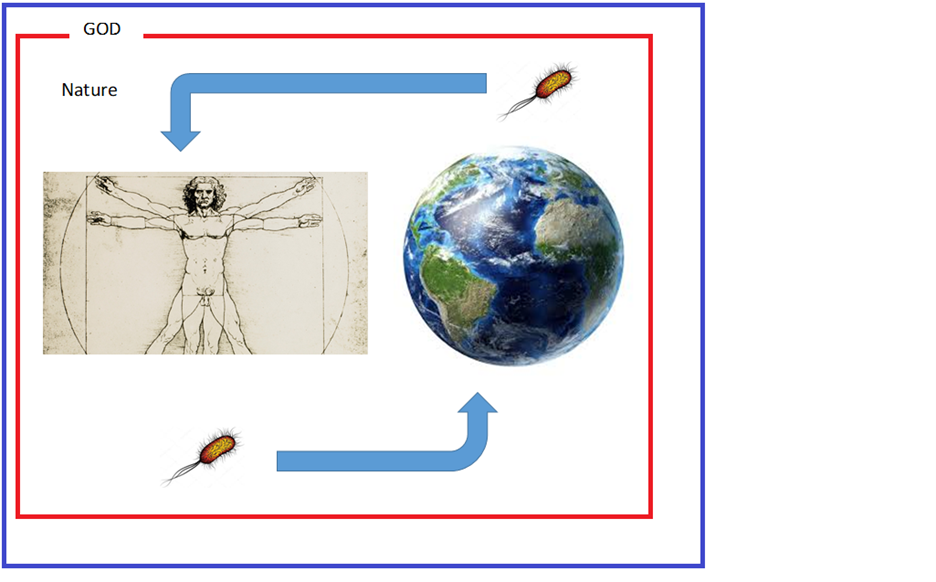
God’s love of the universe and all of its contained entities also should be considered in this setting. One can propose that God so loves the world that God desires creative freedom at all levels of reality which can lead to any outcome. However, there is the potential for limitation of possibilities in two ways. First, since God wants complete freedom in all of nature, then nature can freely put limits on creativity. This limitation theologically can be defined as “lim Δ” or a limit (lim) to change (Δ). Examples of such natural constraints would include the presence of gravity, the mass of the proton, the need for oxygen for Earth on life, etc. Thus, nature but not God can limit creative potential.26 Second, God provides a continuous divine lure for the good or for continuing / increased creativity throughout all of nature and continually through time. This divine lure for creativity is field-like and is present in every nook and cranny of the cosmos. God’s lure is not deterministic and can be followed or ignored at every moment in time. God’s lure is formative but not forceful; enticing but not exacting.26,28
The human microbiome is ripe for theological investigation as more scientific discoveries are made in this field of study. Vital pathways of study include the essence of human nature in the setting of subjectivity, objectivity, and the microbiome; the presence of God experiencing in real time as opposed to an outside-of-time Platonic-type God;29 the ubiquity of God throughout all levels of nature, and metaphysical consequences of panexperientialism especially within the realm of both the microbiome and our species experiencing God.
The author wishes to thank Sy Garte (editor-in-chief for God and Nature Magazine) for allowing me to use the included figure.
References:
- Ursell LK, Metcalf JL, Parfrey LW, et al. Defining the human microbiome. Nutr Rev 2012; 70 (Suppl 1): S38-S44.
- Leviatan S, Shoer S, Rothschild D, et al. An expanded reference map of the human gut microbiome reveals hundreds of previously unknown species. Nat Commun 2022; 13: 3863.
- Carding SR, Davis N, Hoyles L. “Review Article: The Human Intestinal Virome in Health and Disease,” Aliment Pharmacol Ther 2017; 46: 800-815.
- Seed, PC. “The Human Mycobiome,” Cold Spring Harb Perspect Med 2014; 5: a019810.
- Gaci N, Borrel G, Tottey W, et al. “Archaea and the human gut: new beginning of an old story.” World J Gastroenterol 2014; 20:16062-78.
- Schneider T. “The holobiont self: understanding immunity in context.” Hist Philos Life Sci 2021; 43: 99.
- Ogunrinola GA, Oyewale JO, Oshamika OO, et al. “The human microbiome and its impacts on health.” Int J Microbiol 2020; 12: 8045646.
- Glassner KL, Abraham BP, Quigley EMM. “The microbiome and inflammatory bowel disease.” J Allergy Clin Immunol 2020;145:16-27.
- Lin Y, Lau HC, Liu Y, et al. “Altered mycobiota signatures and enriched pathogenic Aspergillus rambellii are associated with colorectal cancer based on multicohort fecal metagenomic analyses.” Gastroenterology. 2022;163:908-921.
- Sampson TR, Debelius JW, Thron T, et al. “Gut microbiota regulate motor deficits and neuroinflammation in a model of Parkinson’s disease.” Cell 2016; 167:1469-1480.
- Friedland RP. “Mechanisms of molecular mimicry involving the microbiota in neurodegeneration.” J Alzheimers Dis 2015; 45: 349-62.
- Hoban AE, Stilling RM, Moloney GM, et al. “Microbial regulation of microRNA expression in the amygdala and prefrontal cortex.” Microbiome 2017; 25: 102.
- Dandekar MP, Palepu MSK, Satti S, et al. “Multi-strain probiotic formulation reverses maternal separation and chronic unpredictable mild stress-generated anxiety- and depression-like phenotypes by modulating gut microbiome-brain activity in rats.” ACS Chem Neurosci 2022; 13:1948-1965.
- Griffin DR. “Scientific naturalism, the mind‐body relation, and religious experience.” Zygon® 2002; 37: 361-380.
- Whitehead AN. Process and Reality. New York: The Free Press; 1978.
- Tabaczek M. “Hegel and Whitehead: in search of sources of contemporary versions of panentheism in the science-theology dialogue.” Theology and Science 2013; 11: 143-161.
- Strawson G. Real Materialism: And Other Essays. Oxford: Oxford University Press; 2008.
- Goff P. Galileo’s Error: Foundations for a New Science of Consciousness. New York: Pantheon; 2019.
- Brüntrup G, Göcke B, Jaskolla, L (eds.). Panentheism and Panpsychism: Philosophy of Religion Meets Philosophy of Mind. Paderborn: Mentis; 2020
- Alteri CJ, Mobley HL. “Escherichia coli physiology and metabolism dictates adaptation to diverse host microenvironments. Curr Opin Microbiol 2012; 15: 3-9.
- Ahn J, Hayes RB. “Environmental influences on the human microbiome and implications for noncommunicable disease.” Annu Rev Public Health 2021; 42: 277-292.
- Weissenborn K, Donnerstag F, Kielstein JT, et al. “Neurologic manifestations of E. coli infection-induced hemolytic-uremic syndrome in adults.” Neurology 2012; 79:1466-73.
- Cryan JF, O’Riordan KJ, Sandhu K, et al. “The gut microbiome in neurological disorders.” Lancet Neurol 2020; 19: 179-194.
- Oord TJ. The Uncontrolling Love of God. Lisle, IL: Intervarsity Press; 2015.
- Oord TH, Schwartz WA. “Panentheism and open and relational theology.” Modern Believing 2022; 63: 134-140.
- Pohl JF. A Theology of the Microbiome. Grasmere, ID: SacraSage Press; 2024.
- Pohl JF. “Panpsychism, the microbiome, and a new christian approach to consciousness.” God and Nature Magazine 2020; https://godandnature.asa3.org/pohl-panpsychism-and-microbiome.html.
- Dorrien G. “The lure and necessity of process theology,” CrossCurrents 2008; 58: 316-336.
- Plato. “Timaeus.” The Internet Classics Archive 2009: https://classics.mit.edu/Plato/timaeus.html.