
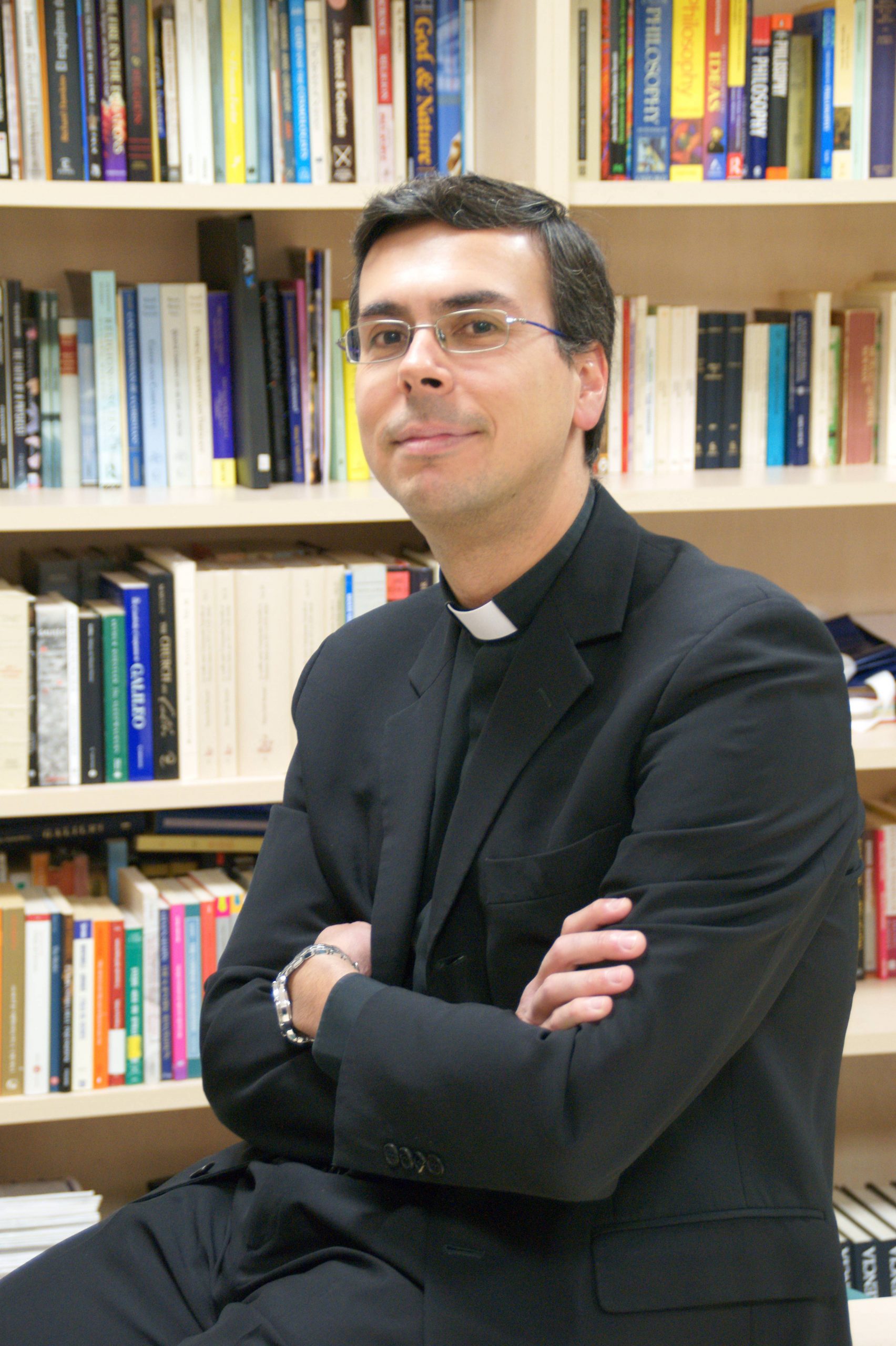
 Prof. Javier Sánchez-Cañizares FISSR, PhD
Researcher
University of Navarra
Pamplona, Navarra, Spain
Biography
PhD in Physics (University Autónoma of Madrid, 1999)
PhD in Theology (Pontifical University of the Holy Cross, 2006)
Biography
Born in Córdoba, Spain (1970), Javier Sánchez-Cañizares studied the degree in Physics at the Autonomous University of Madrid (1993), where he also obtained a PhD with a thesis entitled “Self-consistent description of transport in quasi-one-dimensional superconducting wires” (1999) belonging in the field of Condensed Matter Physics.
In 2001, he moved to Rome for a Bachelor’s and PhD in Fundamental Theology at the Pontifical University of the Holy Cross. This second thesis tackled the revelation of God in creation within the patristic quotations of the Areopagus sermon (Acts 17:16-34). It was supervised the physicist and theologian prof. Giuseppe Tanzella-Nitti.
After being ordained a priest in 2005, he settled in Pamplona (Spain), where he has being teaching at the University of Navarra until the present date, always as a Faculty member. Since 2016 he is Associate Professor of "Science, Reason and Faith" in the CRYF group, founded by late prof. Mariano Artigas. He is also a researcher in the Mind-brain group of the Institute for Culture and Society. He is a professor accredited by the Spanish National Agency for Quality Assessment and Accreditation (ANECA) (2020), and a full professor accredited by the Agency for the Quality of the University System of Catalonia (AQU) (2022).
Currently, he is the leader of the project “Science and Religion in Spanish Schools,” funded during the period 2018-2021 by the John Templeton Foundation, and member of the scientific council of the international interdisciplinary journal “Scientia et Fides.” He is also member of the Society of Catholic Scientists, where he lectured at its 2018 conference on "The Human Mind and Physicalism."
In the fields of Philosophy of Physics and Philosophy of Mind, his research focuses on the Interpretations of Quantum Mechanics and their application to the development of a renewed philosophy of nature. More specifically, he studies the emergence of complex adaptive systems and optimization procedures that ask for a deeper philosophical understanding of natural processes, particularly the emergence of higher human faculties.
Javier Sánchez-Cañizares' book "Universo singular" won one of the 2018 Expanded Reason Awards in the research category, organized on a yearly basis by the Francisco de Vitoria University together with the Vatican Foundation Joseph Ratzinger - Benedict XVI. "Universo singular" introduces the reader in the context of contemporary physics to reveal some singularities that occur in our knowledge of the universe. The existence of these singularities points to an emergence of authentic novelties in nature, appealing to the use of an expanded reason that helps to understand the world we inhabit. The book thus offers a necessary starting point, rooted in science, to renew philosophical reflection on the cosmos.
Honoraria Titles
Father
Major Prizes
Expanded Reason Award in the research category (2018)
Religion, Philosophy & History Interests
Christianity-Catholicism, Ethics, History of Science, Naturalism, Philosophy of Mind, Philosophy of Religion, Theology
Science & Technology Interests
Cosmology, Evolution, Human Origins, Mathematics, Neuroscience, Physics
Website
https://www.unav.edu/html/pdfs/detalleProfesor/146922.pdf
Publications
Universo singular: Apuntes desde la física para una filosofía de la naturaleza
Universidad Francisco de Vitoria 2019
Pages:233
https://www.editorialufv.es/catalogo/universo-singular/
Naturaleza creativa
Rialp 2018
Co-authors: Javier Novo, Rubén Pereda
Pages:196
https://www.rialp.com/libro/naturaleza-creativa_93056/
Razón y fe: la plenitud de la vida moral
Eunsa 2013
Pages:129
https://www.eunsa.es/libro/razon-y-fe-la-plenitud-de-la-vida-moral_100
Moral humana y misterio pascual. La esperanza del Hijo
Eunsa 2011
Pages:254
https://www.eunsa.es/libro/moral-humana-y-misterio-pascual_101162/
La revelación de Dios en la creación. Las referencias patrísticas a Hch 17,16-34
Edizioni Università della Santa Croce 2006
Pages:434
Self-consistent Description of Transport in Quasi-one-dimensional Superconducting Wires
Autonomous University of Madrid 1999
Pages:127
Teleology Writ Large: In Search of New Optimization Principles in Nature
Martin-Luther-University Halle-Wittenberg 2020
Editors:M. Fuller, D. Evers, A. Runehov, K-W. Saether, B. Michollet
Volume:Studies in Science and Theology, Volume 17 (2019-2020): Are We Special
Pages:327-343
Quantum Mechanics: Philosophical and Theological Implications
INTERS 2019
Editors:G. Tanzella-Nitti, I. Colagè, A. Strumia
Volume:Interdisciplinary Encyclopedia of Science and Religion
http://inters.org/quantum-mechanics-philosophical-implications
Classicality First: Why Zurek’s Existential Interpretation of Quantum Mechanics Implies Copenhagen Interpretation
2019
https://link.springer.com/article/10.1007/s10699-018-9574-y?shared-art
The Impact of Religion on Kelvin’s Physical Insights. Thermodynamics and the Age of the Earth
2018
https://dadun.unav.edu/handle/10171/56824
Causation as the Self-Determination of a Singular and Freely Chosen Optimality
2018
Co-authors: Nathaniel F. Barrett
https://philpapers.org/rec/BARCAT-30
Cognitive Inhibition and the Conscious Assent to Truth. A Newmanian Perspective
2016
https://muse.jhu.edu/article/678421
Entropy, Quantum Mechanics, and Information in Complex Systems: A Plea for Ontological Pluralism
2016
http://www.ejst.tuiasi.ro/Files/56/3_Sanchez-Canizares.pdf
The Role of Consciousness in Triggering Intellectual Habits
2014
https://www.frontiersin.org/articles/10.3389/fnhum.2014.00312/full
Whose Design? Physical, Philosophical and Theological Questions Regarding Hawking and Mlodinow’s Grand Design
2014
http://dx.doi.org/10.12775/SetF.2014.011
The Mind-Brain Problem and the Measurement Paradox of Quantum Mechanics: Should We Disentangle Them?
2014
https://www.neuroquantology.com/article.php?id=1148
Formal Causation in Integrated Information Theory: An Answer to the Intrinsicality Problem
Springer Nature 02 January 2021
https://rdcu.be/ccYdi
The Free Energy Principle: Good Science and Questionable Philosophy in a Grand Unifying Theory
MDPI 19 February 2021
Editors:Alexandre Ferreira Ramos and Gábor Balázsi
Volume:23(2)
Pages:238
https://www.mdpi.com/1099-4300/23/2/238


