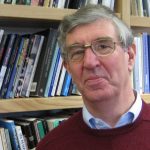
Fraser Watts
ISSR will be starting its next major research project in October this year, our third large research project sense since 2015. This project, on the interface of Artificial Intelligence (AI) and religion/theology, will focus on ‘understanding spiritual intelligence’, and is funded by the Templeton World Charity Foundation, as part of their Diverse Intelligences initiative.
Religion has often shown concern about AI. Some of that concern has focused on the mechanistic view of the human mind to which AI may appear to be committed, or on human and social impact of the increasing digitalisation of work and social life. However, in this project we want to use AI to make a constructive contribution to the understanding of religion. Computational theorising has made a valuable contribution in many areas of psychology, by introducing a new level of rigour and precision. We believe it can make that contribution in the study of religion as well. So far, there has been some promising work on the computational modelling of religious social networks. However, we want to focus in this project on modelling the religious mind.
There has been some interesting discussion about whether or not there is is a distinctive ‘spiritual’ intelligence. For sample, Howard Gardner considers that as part of his theoretical work on multiple intelligences, but in the end favours what he calls ‘existential’ intelligence. We don’t assume that there is a discrete module in the human mind for religious, spiritual or existential intelligence. However, human intelligence does seem to be deployed in distinctive ways in spiritual and religious life, and that is what we want to understand better.
In our project we are planning to open up five different lines of enquiry. That is ambitious, but, our assumption is that it is only by taking initial steps that we will know which of these lines of work it will prove most fruitful to pursue in further work. The senior team includes Yorick Wilks and William Clocksin on the AI side, and Rowan Williams and myself on the religion/theology side. There will be various other research associates and consultants.
One strand of work will focus on religious practices, especially contemplative practices, i.e. how the human mind is deployed in contemplative mode. AI tends to focus on problem-solving, and sometimes seems to assume that all the human mind ever does is to solve problems. However, in contemplation, there is a participatory engagement and apprehension that can’t adequately be characterised as problem-solving. Our plan is to use a model of the cognitive architecture, Interacting Cognitive Subsystems (ICS), to model how attention is deployed in spiritual practices. We will start with mindfulness, on which there is already some preliminary work, but will also look at other spiritual practices such as Hesychasm (the Jesus prayer). There has been some promising recent work using ICS on how attention is deployed in dance, and we hope to do something similar for contemplation.
The second strand of work will focus on religious language. We particularly want to retrieve and develop some of the pioneering work on religious language of Margaret Masterman, a philosopher who was also one of the founding figures in computational linguistics and automated translation, and who also worked on religious language. We believe that her distinctive approach to language continues to have considerable theological significance, and it is discussed at some length by Rowan Williams in the book arising from his Gifford lectures, The Edge of Words. We plan to develop that approach to religious language by looking through three specific lenses, the Tao Te Ching, Japanese Zen Buddhist practice, and dual-systems theories of the social mind.
We also want to use computational modelling to specify how spiritual reasoning might work. There has been a growing emphasis in psychology recently on cognition being embodied, embedded, enacted and extended (the 4 ‘E’s). Those characteristics probably apply in some modes of cognition more than others, but they are particularly important in religious cognition, and are aspects of human cognition that AI has so far found it quite challenging to model. Religious thinking seems to be very socially embedded, in the sense that people develop their religious understanding in a social and interpersonal context. We plan to do some computational modelling to show how that socially-embedded intelligence might work.
We also want to consider what is distinctive about human intelligence, and how it differs from both computer intelligence and from non-human animal intelligence. In broad outline, it seems to be a distinctive feature of human intelligence that we have two alternative ways of doing central cognition. One of these, the more analytical mode, is what AI has so far concentrated on modelling. The other, the more intuitive mode, is the kind of intelligence that humans have in common with other species. We want to explore what is significant about this dual-mode human intelligence from the perspective of the purposes of God, and how it has enabled the development of religion and spirituality in humans. In other words, we want to begin to build a theology of intelligence.
Finally, we will take steps towards building an artificial spiritual companion. The development of artificial companions has been one of the most important practical applications of AI in recent years, and there has been a particular focus on developing artificial companions to help the elderly. We think it is possible to develop a computer program which will make it possible for someone to have a conversation about spiritual matters with their computer. Over time, the computer will increasingly develop an understanding of a particular person’s spirituality, and so be able to provide personalised spiritual support. That will not replace a Spiritual Director, but it could facilitate someone’s spiritual self exploration, just as an early computer program in the 1960s was able to provide people with non-directive counselling.
As with all research projects we will make an effort to disseminate what we are doing, to both those working on AI and on religion/theology. We will also try to interest the general public in how there can be a constructive interface between AI and religion. Yorick Wilks will write a book for the general public, and Fraser Watts expects to be editing (with Beth Singler) a Cambridge Companion on religion and AI. We also hope that there will be an ISSR conference that showcases this research project, rather like the one in 2019 that focused on the project on Religion and the Social Brain.