
Dear ISSR Member,
I hope you had an excellent holiday! I myself enjoyed seeing family and old friends and enjoying snowy walks along Northern Ontario trails. However you spent your time, I trust you are rested and ready for a new year and a new decade.
Before I continue, I would like to remind everyone that our newsletter is composed of items that you send to me that you believe would be of interest to the wider ISSR community. Whether this is research projects, position openings, conferences, call for papers, whatever, our community thrives by being engaged in the excellent work you do and the opportunities and news available in the field of science and religion. If you have anything you would like to share for the first newsletter of 2020, please email it to me at admin@issr.org.uk by end of January. Newsletters will be sent out on the last day of each month, so please get your items sent to me as soon as possible.
Now for the main piece: I personally have never been to an AAR (American Academy of Religions) conference but I have been aware of it for some time and have been told that it is rather a sight to behold. Thousands of academics gather (10,000 according to their website!) for three full days of intellectual and professional development, learning, and (occasionally) good fun. It is good that ISSR has a presence at such an important and large event, and that is what the topic of this month’s blog is all about.
Our own Ron Cole-Turner led the way for ISSR at AAR which was held in San Diego during late November. I am told it was a successful event, and I am pleased to now share with you the blog about AAR and the case for why ISSR should maintain a presence at this annual conference of scholars.
Please enjoy and if you have any questions or comments, please email me.
All best,
Anthony K Nairn
ISSR Admin
Four Reasons to Attend AAR
by Ron Cole-Turner
Ever since 2013, the International Society for Science and Religion has been present at the American Academy of Religion (AAR). Each year, we offer our own sessions to supplement the program presented by the AAR. When you add it all up, the result is a first-rate science and religion “mini-conference,” with top-level presentations attended annually by scholars from around the world.
What makes this really attractive is that the basic AAR program already features sessions organized by AAR program units like “Science, Technology, and Religion” or “Human Enhancement and Transhumanism.” In addition, AAR makes room for experimental sessions, such as the 2018 conversation on religion and artificial intelligence. These AAR-sponsored sessions often feature members of the ISSR in leadership roles. All this is already in place even before ISSR inserts its sessions into the program.
With AAR’s strong and growing science and religion session content already there, ISSR is able to come alongside and add to the mix. Our goal is not to compete but to supplement and enrich the overall science and religion content. In 2018, we offered three events featuring twenty-four of our speakers. Taken as a whole, the 2018 ISSR sessions plus the AAR-sponsored sessions meant that anyone attending the Annual Meeting could choose from roughly ten different sessions with something like fifty presentations that focused one way or another on science and religion themes.
Our assumption, of course, is that thousands of people attend AAR Annual Meetings regularly, often with institutional support. This makes it possible for ISSR to offer its sessions at a very low cost to the society.
At the 2018 meeting in San Diego, we showcased the work of younger, emerging scholars. In a session entitled “GEN XYZ: Futures of Science and Religion,” eight new and emerging leaders in science and religion briefly described their work and how it fit traditional methods in science and religion. Phil Clayton responded, pointing out how the new work tends to avoid broad systematizing themes and focuses instead on particular points in the science-religion nexus, often with more attention than in the past to the ethical or cultural impacts of science and technology. Presenters included Rebekah Wallace, Emily Qureshi-Hurst, Josh Reeves, Jeanine Thweatt, Sarah Lane Ritchie, Bethany Sollereder, Donovan Schaefer, and Kutter Callaway
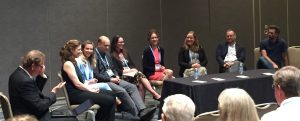
Panel on GEN XYZ: Futures of Science and Religion. Left to right: Phil Clayton, Rebekah Wallace, Emily Qureshi-Hurst, Josh Reeves, Jeanine Thweatt, Sarah Lane Ritchie, Bethany Sollereder, Donovan Schaefer, and Kutter Callaway. Photo by Ben Sanders.
Another ISSR session explored the intriguing question: What happens to “science and religion” when it is no longer clear what we mean by “science” or “religion”? These terms haven’t exactly disappeared, but scholars largely agree that their traditional definitions have been deconstructed or at least de-centered. If we are not entirely sure what each word means, can we still pursue the intersection of “science and religion” as a coherent academic enterprise? The session featured Whitney Bauman, Zainal Abidin Bagir, Alison Lutz, Eduardo Mendieta, Elaine Nogueira-Godsey, Josh Reeves, and Lisa L. Stenmark.
A third ISSR session presented recent work on the relationship between technologies of human enhancement and Christian theological perspectives on human creaturehood. Does being a creature mean saying no to technology? If humans are created for transformation, are we to use technology to achieve it? This session featured Grant Macaskill, Eugenia Torrance, Simeon Zahl, Brandon Gallaher, Ted Peters, Ron Cole-Turner, Celia Deane-Drummond, and Michael Burdett.
Several years ago at one of our sessions, a distinguished ISSR scholar began his remarks by thanking the ISSR for creating these sessions. He said that the reason he was attending AAR was because ISSR was there. What made his comment really striking is that he travelled all the way from another continent.
Was he right? For scholars interested in any dimension of what we still call “science and religion,” does it make sense to attend the AAR Annual Meeting, supplemented as it is by ISSR sessions? Does it offer real value?
Here are four reasons to think so:
- You will make personal connections with international contributors working in science and religion. Join the annual science and religion reception with over 100 established and emerging scholars. Mingle with the key program directors, the main journal editors, post-docs and doctoral students, or leaders like Michael Reiss, ISSR president.
- You will get to know faces and voices, not just the words on pages but living personalities that underlie the perspectives and the debates.
- You will be in a position to understand more clearly current disagreements and misgivings about science and religion as key contributors discuss their work and respond to audience challenges.
- You will discover unexpected convergences between your own work and the efforts of others.
The next Annual Meeting will be in Boston on 21-24 November 2020. ISSR will be there, adding once again to other science and religion events. In early May 2020, you can find information about the meeting at the AAR website, aarweb.org. Early in the fall of 2020, ISSR will send an email describing our events and listing AAR-sponsored events that may be of interest. To get on the email list, please send a note to Ron Cole-Turner at coleturn@pts.edu.
