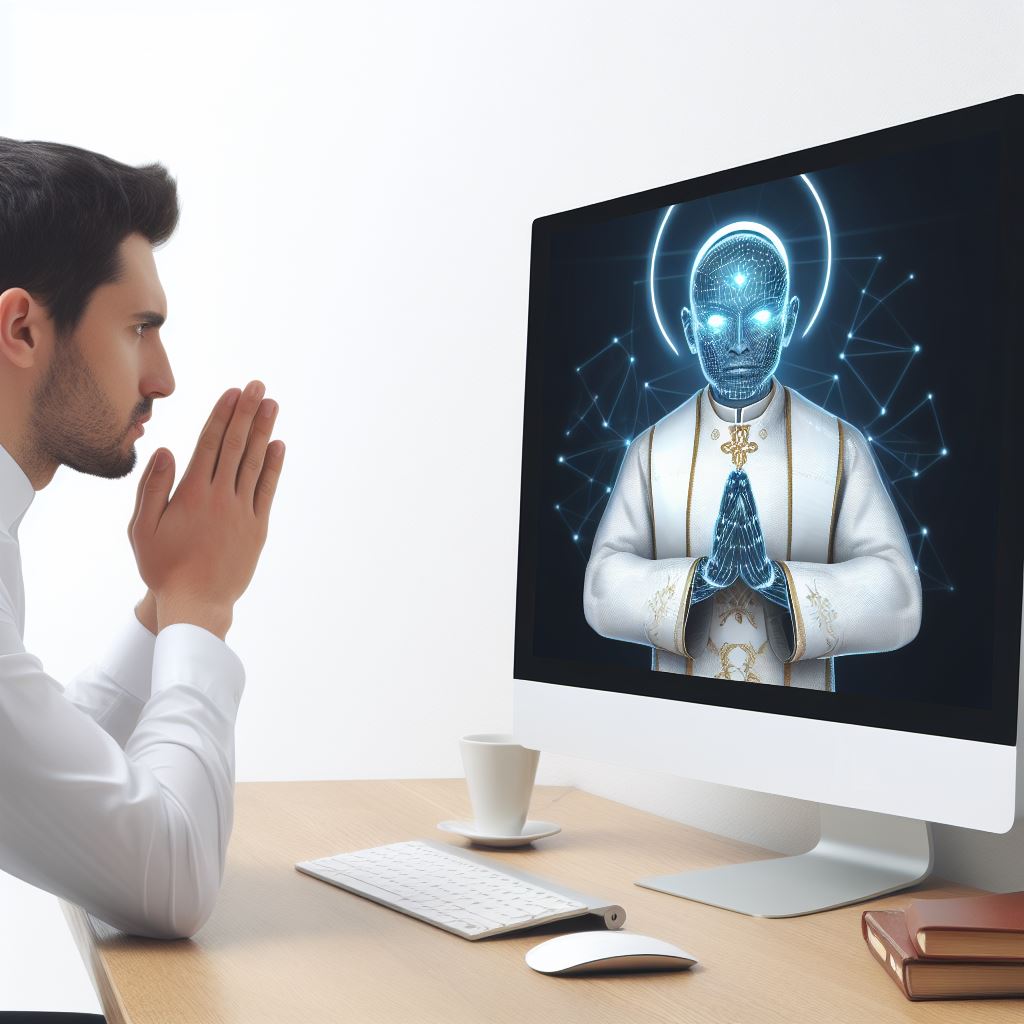
Spiritual Conversation with AI
The development of Open AI (GPT-3 and its successor), has generated huge public interest in the capacity of AI. There is a mixture of excitement about what AI is now capable of, but also alarm about the consequences of these new capacities.
One interesting question, especially for those concerned with the interface between science and religion, is the capacity of AI for spiritual conversation and counselling. Even before the machine learning approach of Open AI, there were indications that automated spiritual conversation might be possible.
The early work of Joseph Weizenbaum in the 1960s, using a simple Chatbot methodology, suggested that computers could perform passably in providing non-directive counselling. The computer simply picked up verbal cues and responded appropriately. So, for example, if the user said word ‘mother’, it might say ‘tell me about your family’. This could be used for non-directive spiritual conversation.
There are also script-based methodologies based on dialogue theory, which are widely used in expert systems. There are various spiritual practices that are sufficiently systematised that it would be possible in principle to program computers to deliver them. That may be true, for example, of some aspects of Ignatian spirituality, and the kind of approach to forgiveness developed by Everett Worthington.
As part of the recent ISSR research project, funded by the Templeton World Charity Foundation, Yorick Wilks (a former Fellow of ISSR who, sadly, passed away recently)
conducted empirical research, with colleagues, on spiritual conversation with a computer, focusing on its acceptability to users.
We began, before GPT-3 was available, with a “Wizard-of-Oz” methodology. Responses appeared to be generated by the computer, but were actually generated by a human who typed what they wanted to say, which was then spoken by an avatar. That enabled us to test the acceptability of spiritual conversation with what was believed to be a computer.
Most users had about four sessions of spiritual conversation with the Wizard/computer. All but one reported that they found it interesting and useful, and had no objection in principle to talking about spiritual matters with a computer.
We then moved on to GPT-3. Technically, that worked more smoothly, in that there were no delays while the Wizard typed their response. Using GPT-3 enabled us to test, not just the acceptability of talking about spiritual matters with what appeared to be a computer, but the acceptability of computer-generated responses.
The responses from the computer were often impressively knowledgeable, as would be expected. Open AI has obviously gobbled up a lot of information about spiritual matters from its huge database. Occasionally it offered what might pass for advice. When asked, “How can we be more spiritual in our own lives?” the avatar said:
To be more spiritual in your own life, try to focus on developing a deeper connection with yourself and the divine. Spend time in nature or meditating to reflect on your inner self and find peace and harmony. Cultivate a sense of gratitude and appreciation for the beauty and joy in life, and practice acts of kindness and compassion for others.
However, many users found GPT-3 limited. The computer’s responses, taken individually, were often convincing and impressive but, over a period of time, its limitations became more obvious. The complaint was that the responses were so stereotyped and formulaic that it was clear that it was an artificial intelligence, with significant limitations. Another user pointed out that the computer was unable to probe the responses that the user said, and consistently lacked depth:
“This system would have to be vastly improved for human use. There was no real discussion – no probing of my beliefs, no asking why, no showing of any real interest in my individual responses, and no challenge to expand upon my beliefs or explore other points of view. Without a meaningful and engaging discussion, why would a person want to use this program?”
Sophisticated linguistic analyses were carried out using transcripts of the sessions. Users tended to speak more in the latter part of the session, suggesting that they were engaged in the conversation. The responses of users were also mapped on to a set of 500 human value words. The conversation tended to proceed from relatively abstract topics in the first part of the session, to more personal ones in the latter part. The same pattern of results was found in both the Wizard and GPT-3 conversations.
In the longer term, it might be possible to develop a personalised spiritual companion. Prior to GPT-3, Wilks had led a project on developing personalised spiritual companions for the elderly, in which the aim was that the computer should acquire sufficient knowledge about a particular person to be able to fulfil many of the functions of a personal companion. It may be possible to develop a somewhat similar personalised spiritual companion, which would become familiar with a particular person’s spirituality.
In his work on personalised companions Wilks used a hybrid of Chatbot methods and script-based expert systems. Hybrid methodologies seem able to out-perform any single system. It would now possible, in principle, to include machine learning in a more complex hybrid methodology, which would probably be superior to Open AI its own. That remains to be investigated.
Overall, AI is currently far from being an adequate substitute for a human spiritual counsellor. However, it is likely that its performance will be improved. Even now it may have value as a supplementary resource, used alongside consulting a human. It seems important not to make exaggerated claims for automated spiritual conversation, which could lead to a backlash against it. Various publications arising from this research are forthcoming.